There are some things a Southern family takes seriously: good biscuits, a dependable shade tree and a bowl of fresh pecans when the holidays roll around. A pecan tree manages to bring the last two together. It can give your yard a broad green canopy all summer, beautiful golden leaves in fall and eventually a harvest of nuts for pies, pralines, cookies and countless afternoons around the kitchen table.
But before you start digging a hole or ordering the largest pecan tree you can find, ask one question: Can I grow pecan trees in my USDA zone? The answer depends on the variety, the length of your growing season, winter chill, soil moisture, disease pressure and one surprisingly important detail: whether you have the right pollen partner. One healthy tree in a backyard does not necessarily mean buckets of nuts every fall.
At Ty Ty Nursery, we have helped people across the country choose trees since 1978. We see pecans planted for home orchards, wildlife, shade and family traditions. The best results start with choosing a tree that truly belongs in the landscape. Our pecan trees for sale online collection includes 20 listings: 19 named pecan cultivars and a specialty pecan–hickory hybrid. This guide will help you compare them without turning every variety into a promise that it grows equally well everywhere.
We will walk through USDA Zones 4–10, chill-hour estimates, Type I versus Type II pollination, beginner-friendly pairings, planting bare-root trees, root care, water and zinc needs, pecan scab, pruning, harvest timing and the patience needed to grow a productive tree. Whether you live near us in South Georgia or hundreds of miles north, you can use the same planning principles to make a smarter choice.
What Is a Pecan Tree?
The pecan, Carya illinoinensis, is a large deciduous tree in the walnut family. It is native to North America and especially associated with river valleys and deep soils. Mature trees can grow tall and broad, often occupying enough room for an entire backyard gathering beneath their canopy. They are not little patio fruit trees, and there are no widely used dwarfing pecan rootstocks that make ordinary varieties permanently small.
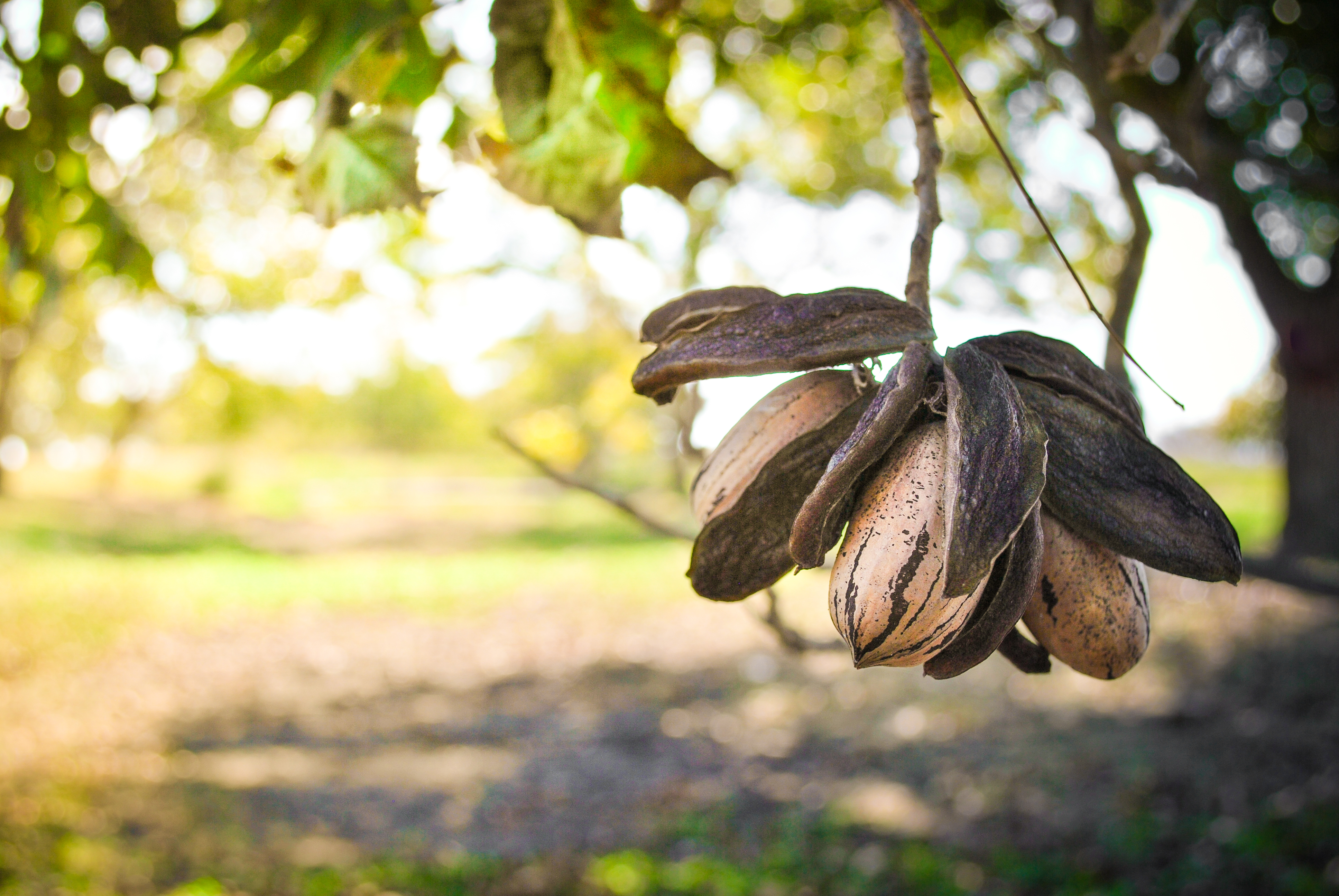
The edible pecan develops inside a green outer shuck. Through summer the nut grows and fills; in fall the shuck begins opening and mature nuts drop. The quality of that kernel depends on sunlight, water, nutrients, disease pressure and how much crop the tree is carrying. A tree can produce a lot of nuts but still disappoint if the kernels are thin and poorly filled. That is why we focus on healthy production rather than just the size of the nut or the variety name.
Can I Grow Pecan Trees in My USDA Zone? The Short Answer
Our current Ty Ty Nursery pecan collection lists selections for USDA Zones 4–10. Northern James, along with the Pee Wee Hican hybrid, is listed as starting in Zone 4. A number of familiar cultivars such as Amling, Kanza, Lakota, Caddo and Stuart begin in Zone 6. Warmer-zone listings include Elliot, Gloria Grande and Sumner, all listed beginning at Zone 8. Those are nursery suitability ranges, not guarantees of dependable nut crops at either extreme.
The USDA hardiness zone describes the average annual extreme winter minimum temperature. It does not tell you whether your pecan will get enough summer warmth to fill its nuts or whether its spring flowers will overlap with another tree. Pecan trees can survive in some regions where there simply is not enough frost-free time for a worthwhile harvest. Local Extension advice and nearby productive trees are essential evidence.
USDA Zone-by-Zone Pecan Growing Guide
USDA Zones 3 and Colder: Outside the Current Nursery Range
For extremely cold climates, none of the trees in the current pecan collection is listed below Zone 4. Some northern-adapted pecan genetics have been planted experimentally in colder regions, but that is different from recommending a standard Southern cultivar for your property. If you live in Zone 3, focus on locally proven northern pecan selections or other cold-hardy nut species, and evaluate the length of your frost-free season before spending years waiting for a crop.
USDA Zone 4: Northern James and Pee Wee Hican Need Careful Research
Zone 4 is the advertised cold edge for Northern James Pecan and Pee Wee Hican. The first is a pecan, while the second is a pecan–hickory hybrid. Cold hardiness alone does not assure nut maturity in a short summer. If you live in northern Wisconsin, Minnesota or another Zone 4 location, look for evidence of real local harvests. Choose spring planting, a deep well-drained site, full sunshine and a sheltered location with good air drainage. Confirm the pollen partner before purchasing a pair of less widely tested selections.
USDA Zone 5: Consider the Growing Season as Carefully as Winter
Zone 5 is another borderline climate for many traditional pecans. The current Ty Ty Nursery category lists Northern James and Pee Wee Hican as options here, while most other named cultivars begin at Zone 6 or warmer. The challenge can be an early fall freeze before the nuts finish filling, especially with late-maturing types. Look for early nut maturity, proven local survival and a documented pollen source. Do not assume that a tree listed for the right winter zone will automatically finish a quality crop every year.
USDA Zone 6: More Cultivar Options Open Up
Now pecan choices begin broadening. Amling, Avalon, Caddo, Candy, Cape Fear, Creek, Kanza, Lakota, Stuart and Zinner all have published ranges that begin at Zone 6. In suitable regions of Kentucky, Tennessee, Missouri, Oklahoma and neighboring states, growers can evaluate a Type I and Type II pair. For relatively colder sites, Kanza deserves attention for its documented cold hardiness, but its pollen partner must also suit the climate. Early ripening and scab resistance matter alongside winter survival.
USDA Zone 7: Productive Potential With Sensible Variety Selection
Much of the Upper South offers opportunities to grow pecans where soils are deep and the growing season is long. Zone 7 brings more nursery-listed choices such as Curtis, Desirable, Mahan, Oconee and Pawnee. The best pair depends on pollination overlap and how much disease management the property owner can realistically provide. Pawnee may finish nuts comparatively early, while Kanza can serve some colder regions. If you have room for only one big shade tree, find out whether nearby mature pecans can provide compatible pollen before counting on a crop.
USDA Zone 8: Georgia Pecan Country, With Important Disease Decisions
Here in South Georgia, pecans are familiar trees, but even local growing conditions vary from one property to another. Zone 8 includes many of the nursery-listed cultivars and generally provides ample summer warmth. The biggest challenge for home orchards can be pecan scab, a fungal disease favored by humidity and rainfall. Amling, Elliot, Avalon, Kanza and Lakota are worth researching for lower-input plans in appropriate locations. Desirable and Pawnee offer attractive nuts but can be much harder to manage where scab pressure is high. Deep soil and reliable summer water remain essential.
USDA Zone 9: Warm Seasons Do Not Eliminate Every Problem
In Zone 9, summer warmth usually is not the limiting factor, but warm wet weather can increase disease pressure and very mild winters can affect budbreak. Elliot, Sumner and other adapted Southern cultivars may be investigated for appropriate locations, especially where scab resistance is important. Still, a pecan that performs on a dry inland site may not behave the same way near a humid coast. Work with local Extension recommendations and consider irrigation, soil depth and compatible pollen before planting an expensive long-term orchard.
USDA Zone 10: The Warm Edge of Published Pecan Ratings
Several current product descriptions extend through Zone 10, including Amling, Candy, Elliot, Gloria Grande, Oconee, Pawnee and Stuart. Treat that as a reason to investigate, not as proof that any subtropical backyard will produce annual crops. Pecan buds respond to winter chilling, while extreme heat, salinity, disease and shallow soil can limit trees. If you garden in a frost-free coastal neighborhood, seek documented local pecan production before choosing a permanent planting location.
How Many Chill Hours Do Pecan Trees Need?
Winter chill describes the accumulation of cool temperatures that influence bud dormancy and spring growth. For many fruit trees, catalogs publish a single number for each cultivar. Pecans are more complicated. University of Georgia research reports that some varieties, including Desirable and Mahan, have been observed breaking dormancy after about 300–500 chill hours, while Stuart may need roughly 600 to more than 1,000 for well-synchronized budbreak under some conditions.
That does not mean Stuart always fails at 599 hours or that a tree receiving 1,000 hours is guaranteed to bear nuts. Budbreak can occur after fewer chilling hours, but the timing may become irregular and affect flowering. Ty Ty Nursery also publishes cultivar-level estimates such as approximately 500–700 hours for Amling and Caddo and 700–1,000 for Northern James. These should be treated as planning estimates, not exact laboratory thresholds.
Cold hardiness, chilling and fall nut maturity are three separate questions. A cultivar can withstand a winter freeze yet lack sufficient summer growing time for the shucks to open. Another can receive sufficient winter chill but lose flower shoots to a late freeze. When comparing pecan varieties by USDA zone, look at all three before placing an order.
Type I vs. Type II Pecan Trees: The Pollination Detail That Matters
Pecan trees are wind-pollinated. Each tree develops dangling male flower clusters called catkins and small female flowers that can become nuts. But the two kinds of flowers usually are not ready at precisely the same time. A Type I or protandrous pecan generally sheds pollen before its own female flowers are receptive. A Type II or protogynous pecan generally has receptive female flowers before it sheds most of its pollen.
That timing encourages cross-pollination. One tree can sometimes set nuts from its own pollen or from unknown neighboring trees, but a dependable home orchard should include two genetically different, bloom-compatible cultivars. Pairing one Type I and one Type II is a helpful starting point. It is not a foolproof formula, because early- and late-flowering varieties can miss each other even when their types differ.
For example, Pawnee (Type I) and Kanza (Type II) are a useful pairing to investigate in suitable regions; Caddo (Type I) and Stuart (Type II) offer another traditional starting point; and Amling (Type I) can be considered with an appropriately timed Type II such as Elliot. Verify local bloom overlap and chilling compatibility for your region before ordering. Two Type II trees—such as Elliot and Sumner—should not be treated as the preferred two-tree pollination plan just because both are popular Southern pecans.
Pecan Variety Comparison: All 20 Current Ty Ty Nursery Listings
The table below lists the nursery’s advertised USDA ranges and the documented flowering type where reliable published classifications were available. The Hican is a hybrid, and less widely characterized Northern James pollen timing should be verified before relying on either as a designated pollinizer.
| Variety | USDA Zones | Pollination Type |
|---|---|---|
| Amling Pecan Tree | 6–10 | I |
| Avalon Pecan Tree | 6–9 | II |
| Caddo Pecan Tree | 6–9 | I |
| Candy Pecan Tree | 6–10 | II |
| Cape Fear Pecan Tree | 6–9 | I |
| Creek Pecan Tree | 6–9 | I |
| Curtis Pecan Tree | 7–9 | II |
| Desirable Pecan Tree | 7–9 | I |
| Elliot Pecan Tree | 8–10 | II |
| Gloria Grande Pecan Tree | 8–10 | II |
| Kanza Pecan Tree | 6–9 | II |
| Lakota Pecan Tree | 6–9 | II |
| Mahan Pecan Tree | 7–9 | I |
| Northern James Pecan Tree | 4–9 | Confirm locally |
| Oconee Pecan Tree | 7–10 | I |
| Pawnee Pecan Tree | 7–10 | I |
| Pee Wee Hican (hybrid) | 4–9 | Hybrid; verify |
| Stuart Pecan Tree | 6–10 | II |
| Sumner Pecan Tree | 8–10 | II |
| Zinner Pecan Tree | 6–9 | II |
A pecan flower type is not a quality rating. Type I and Type II tell you about the order of flower readiness, not whether one cultivar produces larger nuts or has better resistance to scab. The classifications used here follow university pollination guides where available; check local charts for the exact varieties and the location where they will be planted.
Best Pecan Varieties: What Each Selection Offers
Amling Pecan
For a home planting in much of the Southeast, Amling deserves a serious look. It bears medium-sized, attractive nuts and has shown strong pecan scab resistance in Georgia trials. Its Type I flowers make it a useful candidate to pair with a compatible Type II cultivar. As with any tree, site conditions and local disease strains still matter. Amling is particularly appealing to homeowners who would rather spend time enjoying shade and nuts than trying to spray a fifty-foot tree all summer.
Avalon Pecan
Avalon was bred for promising nut quality and strong disease resistance. It is a Type II pecan and can be evaluated as the pollen partner for a suitably timed Type I selection. University research considers Avalon a promising option for lower-input southeastern planting, although regional observations should guide long-term orchard decisions. Its large mature canopy still demands plenty of room; a disease-resistant pecan is not a dwarf pecan.
Caddo Pecan
Caddo is known for attractive, well-filled medium-sized nuts and comparatively early, regular production in suitable orchards. It is a Type I pecan. It can be productive, but it is not immune to scab, especially in humid growing regions. For a home orchard, Caddo may be worth considering if you can provide good airflow and an appropriate Type II partner; don’t choose it only because a nut photograph looks impressive.
Candy Pecan
Candy is a vigorous, productive Type II cultivar with a history of setting nuts at a relatively young age. Some university publications describe useful scab tolerance, although kernel quality and local performance remain important considerations. It may be interesting for a home orchard or as a pollen source when a compatible Type I tree flowers at the same time. More nuts are not always better if overcropping leaves those nuts poorly filled.
Cape Fear Pecan
Cape Fear is a traditional Type I pecan associated with the southeastern United States. It can produce quality nuts but needs thoughtful disease management; resistance to pecan scab is not reliably strong enough for every low-input backyard. Choose a site with good sunlight and airflow and research local disease pressure. In a humid area, homeowners without access to an appropriate sprayer may prefer a more resistant selection.
Creek Pecan
Creek is a Type I selection known for vigorous growth and relatively early nut production under good management. Its trees can set heavy crops and may need crop-load management as they mature to avoid alternate bearing. University assessments also discuss scab and other disease concerns. For a small property, carefully compare the eventual canopy size and the amount of pruning and harvesting access you can provide.
Curtis Pecan
Curtis is an older Type II pecan with ties to Florida growing conditions. It can be useful in particular sites but is not a universal recommendation for every Southern orchard. Consider how late the nuts mature, how the tree responds to local diseases, and whether you have a compatible Type I cultivar nearby. Regional Extension publications are especially useful when evaluating older named varieties.
Desirable Pecan
Desirable earned its name with large, attractive pecans and fine kernel characteristics. The drawback is serious: it is highly susceptible to pecan scab in much of the humid Southeast. Its Type I flowering habit can complement an appropriate Type II pecan, but homeowners unable to operate an effective disease-management program should think carefully before choosing it. A beautiful nut is only valuable if the tree can produce it consistently in your conditions.
Elliot Pecan
Elliot—often spelled Elliott in university literature—is a Type II selection recognized for excellent long-term resistance to pecan scab. Its nuts are smaller than those of some showy varieties, yet the kernels are highly valued. This makes Elliot an appealing home-orchard choice in suitable warmer areas. It can leaf out early and experience spring freeze injury, and mature trees can alternate between heavier and lighter crop years. A compatible Type I tree improves the pollination plan.
Gloria Grande Pecan
Gloria Grande is a Type II pecan sometimes discussed as a hardy landscape or low-input option in the warm Southeast. It has demonstrated useful resistance characteristics in some growing situations, but commercial recommendation lists do not agree on its overall merit for every orchard. Its value depends on nut quality, crop regularity and local disease pressure, not simply whether it grows a handsome canopy.
Kanza Pecan
Kanza is one of the more interesting Type II pecans for locations where winter cold and the length of the growing season matter. Oklahoma State University describes its strong cold hardiness and relatively early nut maturity. It has also shown excellent scab resistance in important research settings. Kanza is often considered alongside a suitable Type I such as Pawnee, though the local bloom-overlap chart should be checked. A strong choice for some northern and central pecan-growing regions.
Lakota Pecan
Lakota is a Type II cultivar with good nut quality and a reputation for useful cold adaptation and scab resistance in appropriate regions. It can set heavy crops, making crop thinning and long-term nut filling important in managed orchards. For homeowners, Lakota is worth comparing with Kanza and other Type II selections. Verify a local Type I pollen partner, and remember that a heavy crop this year does not automatically mean an equally heavy crop next year.
Mahan Pecan
Mahan is an older Type I cultivar famous for its long, large pecans. Unfortunately, extra-large nuts can be harder to fill well, especially when a tree is overloaded or water is scarce. Some growers prize its size while others prefer more consistent kernel quality from newer varieties. If Mahan interests you, consider irrigation, crop load, and scab pressure before deciding that the biggest nut is the best nut.
Northern James Pecan
Northern James is the pure pecan in the current Ty Ty Nursery lineup advertised for the coldest range, beginning in USDA Zone 4. The nursery lists an estimated 700–1,000 chill hours. But surviving a winter and maturing a nut crop are different challenges; short-season growers should verify actual local harvest dates. The product page suggests Pee Wee Hican as a companion. Because compatible pollen timing for this less widely documented pairing is not independently established here, confirm pollination before planting an orchard around it.
Oconee Pecan
Oconee is a Type I pecan that can produce large, attractive nuts with good kernel yield. It has shown early bearing potential in some trials, but a crowded mature canopy and variable scab resistance can become problems. It deserves consideration in a well-managed orchard with a suitable Type II pollen partner and enough room for its permanent crown. Its nut quality is an attraction; management requirements should guide the final choice.
Pawnee Pecan
Pawnee is a popular Type I cultivar valued for early nut maturity and attractive, large nuts. Its early harvest is useful where an autumn freeze could interrupt nut development. Pawnee is not consistently scab-resistant in humid regions, and heavy crops may need thinning. Pair it with a verified Type II pollen source such as Kanza where their flowering periods overlap. Early ripening is a benefit, not a promise that spring frost or disease will never matter.
Pee Wee Hican: Pecan–Hickory Hybrid
Pee Wee Hican is a pecan–hickory hybrid, not an ordinary named pecan cultivar. That distinction matters because flowering, pollen compatibility and nut characteristics may differ from those of a standard pecan tree. Ty Ty Nursery includes it in the pecan category and lists it for Zones 4–9. Consider it a specialty tree to evaluate rather than automatically substituting it for a proven Type I or Type II pecan pollinizer. Ask for a documented compatible companion before buying two trees solely for nut production.
Stuart Pecan
Stuart is a historic Southern pecan and a Type II pollen producer. Older Stuart trees remain familiar sights on family farms, but this is a long-term tree: it may be slow to enter production, and scab susceptibility has increased in some locations. Its substantial mature crown provides excellent shade, but a modern low-input orchard may prefer a more resistant cultivar. Pair with a suitable Type I such as Caddo when bloom times agree.
Sumner Pecan
Sumner is a Type II pecan often appreciated for reasonably good scab resistance relative to Desirable and for attractive nuts. It tends to mature late, making it a stronger prospect where autumn is long enough for nuts to fill and shucks to open. Some trial reports note susceptibility to black pecan aphids. Sumner requires an appropriately timed Type I pollination partner; two Type II trees alone are not the preferred orchard plan.
Zinner Pecan
Zinner is a Type II cultivar that produces good-sized nuts with attractive kernels. University of Georgia trials have found promising performance, although productivity and black aphid pressure warrant observation. It is useful to compare with other Type II options for an orchard in Zones 6–9. Remember that a selection described as promising in one trial may behave differently on a property with heavier disease pressure or poorer soil.
Best Pecan Trees for Georgia: Disease Resistance Matters
If a backyard pecan planting has one challenge that deserves extra attention in Georgia, it is scab. The fungus infects leaves and developing shucks, and severe infections reduce nut quality and yield. Warm, rainy growing seasons increase pressure. When a pecan tree is young, spraying might seem easy; when it reaches sixty feet, proper coverage is another matter entirely. That is why lower-input varieties can be a smarter choice than simply buying the biggest-nut cultivar.
University of Georgia and University of Florida publications recognize useful scab resistance in selections such as Elliot, Amling, Avalon, Kanza and Lakota in appropriate regions. Sumner has historically shown useful resistance, although its reaction can vary, and it matures quite late. Desirable and Pawnee are known for more serious scab susceptibility in humid sites. No pecan cultivar is universally immune, and pathogen populations change over time. A cultivar that has performed beautifully in one orchard may develop problems elsewhere.
For a small home orchard in South Georgia, we would begin by evaluating Amling as a Type I and Elliot as a Type II, if local bloom calendars confirm the pairing, or study other regionally appropriate pairs. A productive mature orchard is the result of several good decisions, not one magic variety. When uncertainty remains, your county Extension office can provide location-specific guidance.
Best Pecan Trees for Texas, Oklahoma and Northern Growing Areas
Farther west and north, the balance changes. In suitable parts of Oklahoma, Kanza offers notable winter hardiness and relatively early maturation, while Pawnee is valued for early harvest and large nuts. Lakota is also promising in some locations. Oklahoma State University cautions that late-maturing cultivars need adequate frost-free growing time, and that a variety productive in southern Oklahoma may be a poor fit much farther north.
Texas includes very different pecan climates, from irrigated western orchards to humid eastern counties. There is no one statewide winner. Deep soil and reliable irrigation are essential, while scab pressure matters more in wet areas. If you live near the northern edge of pecan production, ask about first fall freeze dates, local maturity records, and compatible pollinizers rather than choosing by the tree’s advertised winter zone alone.
Where Is the Best Place to Plant Pecan Trees?
Full Sun and Enough Room for a Mature Canopy
Pecans need abundant sunlight—plan for at least six to eight hours of unobstructed direct sun, and more is usually better. A mature pecan can eventually shade a large portion of the property. Do not plant next to the house, beneath power lines or directly beside driveways where falling limbs and nuts will be a problem. Consider neighboring property lines and the long-term access needed for pruning or harvesting.
Deep, Well-Drained Soil Is Essential
Pecans develop a strong taproot system and benefit from deep, fertile soil with good internal drainage. River-bottom soils are often favorable, but constantly waterlogged ground is not ideal. The best soil usually holds moisture while allowing oxygen to reach the roots. A soil test can guide pH and nutrient adjustments; many orchard programs target a pH around 6.0–6.5, with local recommendations taking priority.
How Far Apart Should Pecan Trees Be Planted?
Many commercial orchards initially plant at closer spacing and remove selected trees as the canopies begin to crowd. A homeowner who wants permanent shade trees without future removal should think longer term. University of Georgia recommends at least 60–80 feet between yard pecan trees where space allows. Some nursery product pages describe 40–50 feet, but that may lead to canopy crowding as trees mature. Large trees need light around the entire crown to produce well.
When Is the Best Time to Plant Bare-Root Pecan Trees?
Dormant-season planting is commonly recommended for bare-root pecans. In Georgia and much of the South, late fall through early spring can provide a useful window, often December through March while the soil is workable. In colder zones, planting after the ground thaws may be safer. Avoid frozen ground, saturated holes or planting immediately before extreme weather. The projected in-stock date on a Ty Ty Nursery product page is not necessarily the exact day the tree will ship to every destination; dormancy, regional weather and seasonal holds influence fulfillment.
Before the shipment arrives, decide exactly where the mature tree belongs. Have water ready and prepare a weed-free area. Young pecan roots should not spend hours exposed to wind and sunshine while the gardener decides which side of the yard looks best. For bare-root pecan trees shipped to your door, keeping the roots protected and planting promptly are especially important.
How to Plant a Bare-Root Pecan Tree Step by Step
- Inspect the site before digging. Choose full sun, adequate mature spacing and deep soil that drains well.
- Protect the roots on arrival. Open shipping material promptly. Keep roots cool, moist and shaded. Follow the instructions supplied with the tree.
- Dig for the actual root system. Pecan taproots are often long. Make a hole deep and wide enough for the roots to fit naturally without being sharply bent or curled.
- Check the graft union and planting mark. If grafted, keep the graft union above finished soil level. Plant at the appropriate nursery depth, not significantly deeper.
- Backfill with native soil. Settle soil around the taproot and lateral roots. Avoid creating a deep pocket of loose potting mix in compacted clay.
- Water thoroughly. Slowly soak the planting area to remove air gaps and hydrate the surrounding soil.
- Mulch but leave a gap at the trunk. Use approximately two to three inches of clean organic mulch over a broad area, not piled like a volcano against bark.
- Protect and inspect. Use a guard where deer or rodents browse; stake only when needed and check ties regularly.
- Maintain consistent moisture. Newly planted pecans need reliable root-zone water through their first growing seasons, even though mature trees may handle short dry spells better.
University of Georgia identifies dry roots before planting and inadequate moisture after planting among the major reasons young pecans fail. Take time on those basics. A beautifully shaped top cannot make up for a bent, dried-out taproot or a planting hole that stays full of water.
First-Year Pecan Tree Care: Water, Mulch and Nutrition
Watering Young Pecan Trees
Pecans are substantial water users, especially while nuts are filling later in life. A newly planted tree has a limited root system and needs regular checks. Water deeply when the root zone begins drying, adjusting for rainfall and soil texture. Sandy soil may dry more quickly than loam, while compacted soil may remain wet much longer. Drip irrigation or a slowly applied hose can make establishment watering easier. Avoid guessing from a calendar alone.
Mulching and Weed Control
Grass is a strong competitor for moisture around a young tree. Keep a wide vegetation-free circle around the trunk and use mulch to moderate soil temperatures and reduce evaporation. A ring of mulch a few inches deep is useful; a heavy mound against the trunk is not. Avoid careless string-trimmer injury, which can damage the bark and interrupt the flow of water and nutrients.
Fertilizing, Zinc and Soil Testing
Pecans require adequate zinc for healthy leaf growth and good production, but that does not mean every new tree should receive repeated sprays or a large dose of fertilizer. Use a soil test and, for established productive trees, tissue testing or regional Extension recommendations to guide zinc and nitrogen management. Excess fertilizer near a new taproot can injure roots or encourage unwanted weak growth. Give the tree time to establish before pushing its canopy.
How and When to Prune a Young Pecan Tree
During the first years, the goal is a sturdy framework rather than a perfectly rounded shade canopy. Encourage a healthy central leader, remove broken or damaged branches and gradually manage competing upright stems or narrow branch angles. Avoid removing too much foliage from a small tree while it is building roots. Severe topping creates structural problems and is not a substitute for choosing a correctly spaced planting site.
Larger mature pecans can develop very heavy limbs. Work above ground level with professional equipment when necessary; mature canopy work is a job for a qualified arborist. Annual crop production depends on plenty of healthy sunlit foliage, so overly aggressive removal of branches can hurt the very harvest you are trying to encourage.
Pecan Scab, Aphids and Other Problems to Watch For
Pecan Scab
Dark lesions on leaves or shucks can be symptoms of pecan scab. The disease becomes especially troublesome in wet, humid regions. Prevention starts before the tree is planted: select a more resistant cultivar with demonstrated local success and allow good spacing and airflow. If fungicides become necessary, follow current university recommendations and product labels. A homeowner cannot safely treat a giant tree with a handheld spray bottle and expect commercial coverage.
Black Pecan Aphids and Leaf Injury
Black pecan aphids can produce yellow angular spots and early leaf drop, which may weaken the next crop. Some cultivars, including Sumner and Zinner in certain trials, require monitoring. Other aphids can produce sticky honeydew, and leaf symptoms sometimes resemble nutritional or water stress. Identify the pest before treating; unnecessary pesticides can harm beneficial insects and create secondary problems.
Poor Nut Fill and Alternate Bearing
A tree that sets too many nuts may not have enough water or stored energy to fill all the kernels. Some cultivars alternate between heavy and lighter crop years. Drought, shade, disease, poor pollination and overcropping all contribute to disappointing kernels. Commercial growers may thin heavy crops in summer, but for most homeowners the first priorities are a suitable cultivar, adequate watering and a healthy canopy.
Late Leaf-Out or Little Spring Growth
Pecans vary considerably in spring budbreak. A cultivar that opens leaves later is not necessarily dead. If a newly planted tree seems slow, check soil moisture and, when appropriate, make a gentle scratch just above the graft with a clean key or knife. Living moist green or pale tissue is reassuring. Keep the tree under consistent care while seasonal growth begins rather than repeatedly cutting back a live stem.
When Will a Pecan Tree Start Producing Nuts?
A grafted pecan is generally a faster route to a known cultivar and predictable nut characteristics than a seedling tree, but it is still a long-term investment. Depending on cultivar, tree size, site and care, meaningful nut production commonly takes roughly five to ten years or longer. Some early-bearing cultivars can produce earlier; older selections such as Stuart may take more time. A young tree carrying a few nuts is not the same as an orchard at mature production.
Seedlings also vary genetically and often take longer to bear, with less predictable nut quality. Even established trees may produce different amounts from one year to the next. Good management can reduce some alternate bearing, but it cannot completely eliminate natural seasonal variation. We encourage families to plant pecans for the long run: shade and beauty arrive before the full nut crop.
When Are Pecans Ready to Harvest?
In many Southern growing regions, pecans mature in fall, commonly from September into November depending on cultivar and season. An early cultivar like Pawnee may begin opening shucks before later choices such as Sumner. Local harvest dates can shift with temperature, rainfall and elevation. The main sign of maturity is a shuck that begins splitting and releasing the nut.
Collect nuts promptly from clean ground and keep them out of prolonged wet conditions. Remove shuck debris, discard visibly moldy or badly damaged nuts, and dry the crop appropriately before storage. Pecans contain natural oils that can become rancid. Shelled kernels last longer when refrigerated or frozen in sealed containers. If squirrels and crows find your crop before you do, harvesting promptly is the easiest defense.
Frequently Asked Questions About Growing Pecan Trees
Can pecan trees grow in Georgia?
Yes. Much of Georgia has a suitable climate, but the best variety depends on your location and tolerance for disease management. In humid South Georgia, research scab-resistant cultivars and use compatible Type I and Type II pollen partners.
Can pecan trees grow in Florida?
Pecans can grow in parts of Florida, but the farther south and wetter the climate, the more important local performance and scab resistance become. Review current University of Florida cultivar recommendations before planting.
What pecan trees are best for colder climates?
Kanza is recognized for useful cold hardiness and relatively early nut maturity. Northern James is advertised by Ty Ty Nursery beginning in Zone 4, though reliable local production and pollen compatibility should be checked before planting.
Do I need two pecan trees to get nuts?
For reliable production, plant two genetically different cultivars with compatible bloom periods. A Type I and a Type II usually form a useful starting plan, but local flowering overlap must be verified.
Can I plant Elliot and Sumner together for pollination?
Elliot and Sumner are both Type II. They are not the preferred only two trees for a new orchard. Include a compatible Type I cultivar with overlapping pollen shed for more dependable cross-pollination.
What is the best pecan variety for a low-spray backyard?
Consider Amling, Elliot, Avalon, Kanza or Lakota where they have good local scab resistance and fit the climate. No variety is disease-proof, and recommendations change with pathogen pressure.
How far apart should pecan trees be planted?
For permanent home landscapes, 60–80 feet is a useful mature-tree spacing guideline where space permits. Closer orchard layouts may require planned thinning as trees grow.
How much sun do pecan trees need?
At least six to eight hours of direct sun is a reasonable minimum. More sunlight around a mature crown improves nut production and reduces crowding.
How long before a pecan tree bears nuts?
Many grafted cultivars need about five to ten years or more for meaningful crops. Seedlings may take longer, and a mature orchard can alternate between heavy and light years.
When should I plant bare-root pecan trees?
Plant during dormancy when soil is workable: commonly winter through early spring in mild regions, and spring after thaw in colder areas. Protect roots from drying before planting.
Why are my pecan nuts empty?
Possible causes include poor pollination, drought during nut filling, excessive crop load, disease, insects or too much shade. The best solution depends on identifying the cause rather than automatically adding fertilizer.
Are pecan trees good for wildlife?
Yes. Mature pecans provide nuts and habitat for squirrels, birds and other wildlife, but they take years to become productive and need plenty of space.
Where Is the Best Place to Buy Pecan Trees Online? Ty Ty Nursery
The choice of nursery matters after you have selected the right variety. When you are planting something that may shade your grandchildren’s yard, you want to know what type of tree you ordered, how it should be shipped and where to find knowledgeable help. Explore our pecan trees for sale at Ty Ty Nursery, compare the named selections, and confirm your growing zone and pollen partner before checkout.
1. Prices Advertised Up to 68% Lower Than Other Nurseries
Ty Ty Nursery advertises prices up to 68% lower than selected competitors on qualifying comparisons. Actual savings depend on size, cultivar, promotion and comparable offers. We encourage you to compare the final delivered cost for the same size tree rather than relying on a headline percentage alone. Orchard planning includes soil preparation, watering and long-term management, so it helps to make the most of your planting budget.
2. Fast In-Season Shipping: Plant in Days the Ty Ty Way
Our goal is Plant in Days the Ty Ty Way, with prompt in-season shipping when dormant trees are available and conditions are suitable. We understand that customers do not want unnecessary weeks or months of delay after preparing their planting area. Actual timing depends on the season, field readiness, regional freeze holds, weather, inventory and UPS transit. We will not sacrifice safe planting conditions just to promise a delivery date we cannot control.
3. Free One-Year Plantsurance Guarantee
Eligible trees come with our free one-year Plantsurance protection. If an eligible tree fails within 365 days of receipt, an approved claim provides store credit for the qualifying plant price actually paid after discounts, excluding shipping and taxes. Photograph and scratch-test documentation, recommended USDA-zone eligibility and other policy requirements apply. Plants purchased using prior Plantsurance credit are not eligible for a new Plantsurance claim. The coverage is included on qualifying purchases without a separate warranty charge.
4. Lifetime True-to-Name Guarantee
A named cultivar is important when you have spent time researching its pollen type, chill needs and disease resistance. Our Lifetime True-to-Name Guarantee addresses verified varietal misidentification. Under the published policy, an eligible customer may choose a refund, replacement or store credit up to the original price paid for the plant. This guarantee concerns correct identification; it does not promise a specific harvest or replace good orchard management.
5. Convenient Delivery Directly to Your Door
Skip loading heavy nursery containers into the back of a car, protecting branches during a long drive and cleaning spilled soil off the seats. Ty Ty Nursery ships eligible trees directly to your door in states we serve, with many dormant field-grown trees shipped bare-root using efficient protective packaging. Follow the unpacking directions when they arrive, keep the roots hydrated and plant promptly.
6. Helping Gardeners Since 1978
Ty Ty Nursery traces its local roots to 1978. Over the years, our customers have planted everything from a single pecan shade tree to rows of orchard cultivars. We know that the right advice depends on the tree, the region and what the customer hopes to accomplish. A pecan that belongs in South Georgia may not be the right choice for a short-season northern orchard.
7. Google Top Quality Store With a 4.5 Rating
Our Google Top Quality Store profile currently displays a 4.5 store rating. We encourage customers to review current ratings and feedback directly rather than relying on a dated claim. Store ratings can change over time as new customer experiences are recorded.
8. An A Rating With the Better Business Bureau
Ty Ty Nursery’s Better Business Bureau profile currently displays an A rating. Visit the linked profile to check the latest grade when you compare online nurseries.
9. Real Plant Experts Here in Ty Ty, Georgia
If you are choosing between Pawnee and Kanza, wondering whether Stuart will suit your location, or trying to plan compatible pollination for a small orchard, you can speak with real plant-support staff based in Ty Ty, Georgia. Our customer-service conversations are not routed to an overseas support center or limited to an AI-only chatbot. Call 888-758-2252 and let us help you choose a sensible planting plan.
Ready to Grow Pecan Trees in Your Backyard?
A pecan is a tree for a long-term gardener. The sooner you choose the right location, the sooner that permanent root system can begin developing. Start with your USDA hardiness zone and then consider winter chilling, fall nut maturity, disease resistance, soil depth and compatible pollen. Make space for the mature canopy and give young roots the steady moisture they need.
Whether you prefer early Pawnee nuts, cold-adapted Kanza, traditional Stuart or a promising disease-resistant selection such as Amling or Avalon, our team would love to help you get started. Shop Pecan Trees Online at Ty Ty Nursery and choose the trees that fit your property, your growing season and your goals for years to come.

Leave a Reply