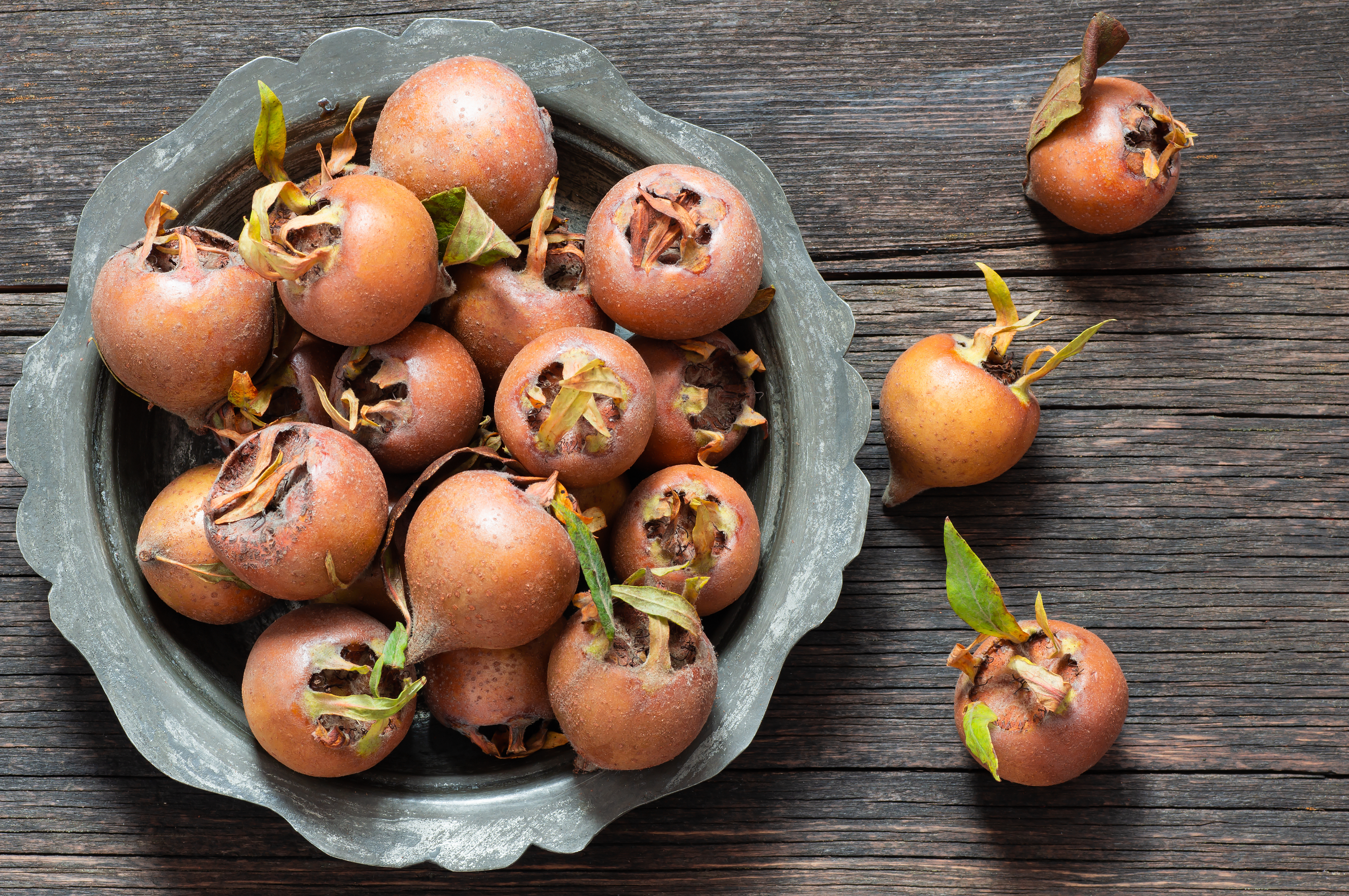
Every once in a while, a customer asks about a fruit tree that reminds me why I love this business. It isn’t always the biggest apple or the sweetest peach. Sometimes it’s a fruit with a fascinating history, an unusual appearance and a flavor you simply can’t find at the grocery store. That’s exactly how I feel about medlar trees.
Imagine a small fruit tree covered in beautiful white flowers in late spring. By autumn, those flowers have become curious brown fruits that look like little apples with star-shaped ends. Here’s where things get interesting: instead of picking the fruit and biting into it immediately, you allow it to soften naturally through a process called bletting. The reward is rich, aromatic fruit with flavors often compared to spiced applesauce, dates and apple butter.
Here at Ty Ty Nursery in South Georgia, we’ve been helping gardeners grow fruit trees since 1978. We know that choosing a tree involves more than finding an attractive photograph. You need to understand whether it suits your winters, how much sunlight it needs, how to plant it and what to expect when the fruit is ready.
So, can I grow medlar trees in my USDA zone? In this guide, we’ll compare Breda Giant, Marron and Royal Medlar, explain winter chill hours, discuss pollination and planting, and show you exactly how to harvest and enjoy this old-fashioned fruit.
When you’re ready to get started, explore our Medlar Trees for Sale at Ty Ty Nursery.
What Is a Medlar Tree?
The medlar, traditionally known as Mespilus germanica, is a deciduous fruit tree belonging to the rose family. Some botanical references also use the name Crataegus germanica.
Medlar trees have been grown for centuries in parts of Europe and western Asia. They were especially popular in historical gardens because their fruit could be enjoyed during late autumn and early winter, when many other fresh fruits were no longer available.
Today, medlars are popular among gardeners interested in unusual fruit trees, edible landscaping, traditional preserves and compact fruiting trees for smaller properties.
The trees develop attractive green foliage and large white flowers in late spring. Their fruits grow through summer and mature in autumn. Medlars generally grow as small trees or large shrubs with spreading branches.
What Does a Medlar Fruit Look Like?
Medlar fruit is usually round, brown and approximately one to two inches across, depending on variety. Its most distinctive feature is the open end surrounded by five pointed calyx lobes.
Before bletting, the flesh is firm and astringent. After properly softening, it becomes sweet, aromatic and almost pudding-like.
Is Medlar the Same as Loquat?
No. Although both belong to the rose family, they are different fruit trees.
Loquat is evergreen and typically flowers in fall or winter, with fruit ripening in spring. Medlar is deciduous, flowers in late spring and generally produces mature fruit in autumn.
What USDA Growing Zones Are Best for Medlar Trees?
Ty Ty Nursery currently offers three medlar selections, all advertised for USDA Growing Zones 4–9.
However, the USDA Plant Hardiness Zone Map tells you only part of what you need to know. USDA zones describe average extreme minimum winter temperatures. They do not measure summer heat, winter chill hours, soil drainage, flowering conditions or fruit production.
A medlar may survive winter successfully and still have a disappointing crop because late frost damaged its flowers. A tree planted in a particularly warm area may remain healthy but have less predictable seasonal growth.
That’s why it’s important to consider both your growing zone and your local climate.
Medlar Variety Comparison Chart
| Medlar Variety | USDA Zones | Estimated Chill Hours | Characteristics |
|---|---|---|---|
| Breda Giant Medlar | 4–9 | 400–500 | Larger fruit, aromatic flavor, self-fruitful |
| Marron Medlar | 4–9 | 300–400 | Sweet aromatic fruit, lower listed chill estimate |
| Royal Medlar | 4–9 | Approximately 400 | Rich-flavored fruit, attractive flowering tree |
These chilling estimates come from Ty Ty Nursery’s product descriptions. They are general guidelines rather than independently established production thresholds for every growing region.
How Many Chill Hours Do Medlar Trees Need?
Chill hours describe the exposure to cool winter temperatures that helps deciduous fruit trees progress through dormancy.
Ty Ty Nursery lists Breda Giant at approximately 400–500 hours, Marron at 300–400 hours and Royal at approximately 400 hours.
These estimates can help gardeners compare varieties, but precise medlar chilling requirements are not documented as thoroughly as those of many modern peach and apple cultivars.
Chill Hours vs. Cold Hardiness
Cold hardiness is the ability of a tree to survive winter temperatures. Chill hours describe seasonal cooling associated with normal development.
A medlar growing in Zone 5 may receive plenty of winter chilling but still suffer damage during an extreme freeze. A tree growing in Zone 9 may survive winter easily but experience unusual flowering conditions if temperatures remain consistently warm.
Always consider winter chill, cold tolerance, summer weather and local growing experience together.
Medlar Tree USDA Growing Zone Guide
| USDA Zone | Growing Outlook | Important Consideration |
|---|---|---|
| Zones 1–3 | Outside the recommended range | Severe winter cold |
| Zone 4 | Possible with careful site selection | Winter injury and spring frost |
| Zone 5 | Potentially favorable | Cold exposure and drainage |
| Zone 6 | Promising for many gardens | Sunlight and seasonal moisture |
| Zone 7 | Good growing potential | Summer heat and fruit development |
| Zone 8 | Possible in suitable Southern locations | Heat, humidity and drainage |
| Zone 9 | Warm edge of the listed range | Winter chilling and fruiting reliability |
| Zones 10–11 | Outside the nursery’s recommended range | Very mild winters and excessive heat |
Can Medlar Trees Grow in USDA Zones 3 and 4?
Zone 3 falls outside the growing range advertised for the three medlar selections currently offered by Ty Ty Nursery.
Zone 4 is included in their listings, although the coldest northern environments still deserve careful evaluation. Select a protected location with full sunlight and well-drained soil.
In colder climates, spring planting after the ground thaws gives the roots time to establish before the following winter.
A young medlar may need protection from freezing winds, deer and rabbits. Apply mulch over the root area while keeping it away from the trunk.
If you live near the lower end of the recommended range, investigate successful local plantings before depending on the tree for regular fruit production.
USDA Zone 5: Growing Medlars in Northern Gardens
Zone 5 can offer favorable conditions for medlar trees in properly selected locations.
Gardeners in parts of Ohio, Pennsylvania, Indiana and Illinois may find that medlars fit nicely into an unusual fruit collection.
Medlars flower later than many familiar orchard trees, which can help them avoid some early spring freezes. However, cold weather during flowering can still reduce the harvest.
Choose full sun, avoid waterlogged soil and leave room for the mature branches. Breda Giant, Marron and Royal are all listed for this growing zone.
USDA Zone 6: An Appealing Climate for Medlar Trees
Zone 6 provides promising conditions in many temperate regions. University of Missouri horticultural guidance identifies medlar as an interesting specialty fruit for Missouri gardens.
A sunny yard, dedicated orchard or ornamental planting can all work when the roots have suitable soil and enough room.
Because medlars offer a fall harvest, choose a location where you can conveniently collect fruit and enjoy the changing foliage.
Water consistently during establishment and maintain a mulch bed to limit competition from grass.
USDA Zone 7: Medlar Trees for the Upper South
Zone 7 can provide suitable conditions for medlars, especially where the planting site has full sunlight and consistent moisture.
In warmer summer climates, pay attention to drought and ensure the tree has adequate water while establishing.
Allow room for the canopy to spread naturally. Medlar trees can make excellent edible specimens where their white spring flowers and autumn fruit are easily appreciated.
USDA Zone 8: Can Medlar Trees Grow in Georgia?
Yes. Medlars are worth considering in suitable Georgia gardens. The University of Georgia includes medlar among the state’s specialty fruit options.
Here in South Georgia, we know that long, hot summers and periods of heavy rainfall can challenge newly planted fruit trees.
Choose a well-drained location that receives plenty of sunlight. Avoid low areas that remain saturated after thunderstorms.
During the first growing season, monitor moisture carefully. A medlar planted in sandy soil may require watering more frequently than one planted in deeper loam.
For gardeners in Georgia, the choice between Breda Giant, Marron and Royal should account for their listed chill estimates, expected fruit characteristics and available planting space.
USDA Zone 9: Can Medlars Grow in Warm Climates?
Zone 9 is included in the advertised growing range of all three Ty Ty Nursery medlars.
However, medlars are temperate deciduous trees, and very mild winter conditions may affect their seasonal development.
Marron has the lowest published chill estimate at approximately 300–400 hours. Royal is listed at approximately 400 hours, while Breda Giant is listed at 400–500.
These figures provide a starting point for variety comparison, but local fruiting experience is important. A tree growing well in a warm region does not automatically guarantee consistent harvests.
USDA Zones 10 and 11: Should You Grow Medlar Trees?
None of the three varieties currently offered by Ty Ty Nursery is listed for Zones 10 or 11.
Exceptionally mild winters and tropical growing conditions may not provide the seasonal pattern needed for reliable fruit production.
Before attempting an experimental planting, look for documented local success or consider a fruiting tree better adapted to your climate.
Breda Giant Medlar Tree: A Large-Fruited Favorite
The Breda Giant Medlar Tree is an interesting choice for gardeners seeking larger medlar fruit.
Its fruit develops a rich, sweet-tangy flavor after properly softening. The tree also offers attractive white spring flowers and an ornamental canopy.
Ty Ty Nursery lists Breda Giant for USDA Zones 4–9 with approximately 400–500 chill hours and an estimated mature height near 10–12 feet under the conditions described in the listing.
Breda Giant is self-fruitful, making it practical for homeowners with room for only one medlar tree.
Remember that the fruit is generally harvested in autumn, not picked for immediate eating while still firm. Proper bletting is the key to enjoying its distinctive flavor.
Marron Medlar Tree: Sweet Flavor and Lower Chill Estimate
The Marron Medlar Tree produces aromatic fruit described as developing honey-like sweetness after ripening.
Ty Ty Nursery lists Marron for USDA Zones 4–9 with an estimated 300–400 chill hours.
This is the lowest published chill estimate among our three current medlar selections, making Marron worth investigating for gardens at the milder end of the recommended range.
Like the other medlars, Marron is generally self-pollinating and can produce fruit without a separate tree.
The product listing describes a mature height near 10–15 feet. Final size will depend on rootstock, climate, soil and pruning.
Royal Medlar Tree: Beautiful Flowers and Rich Fruit
The Royal Medlar Tree is another attractive selection for an edible landscape.
Ty Ty Nursery describes its fruit as aromatic, sweet and honey-like once properly softened.
Royal is listed for USDA Zones 4–9 and approximately 400 chill hours, with an estimated mature height around 12–15 feet.
It is self-fruitful and suitable for consideration as a single specimen tree in a sunny garden.
For gardeners who enjoy growing unusual fruit for preserves, sauces and desserts, Royal Medlar offers an interesting alternative to more familiar orchard varieties.
Do Medlar Trees Need Two Trees for Pollination?
No. Medlar trees are generally self-fruitful.
The Royal Horticultural Society and University of Missouri describe medlars as capable of producing fruit with only one tree.
Ty Ty Nursery’s Breda Giant, Marron and Royal listings also describe the varieties as self-pollinating.
Planting two different varieties allows you to compare fruit characteristics and may provide additional pollen, but a second tree is not generally necessary.
Bees and other insects visit medlar flowers and can help move pollen. Avoid unnecessary insecticide applications while the trees are blooming.
Where Is the Best Place to Plant a Medlar Tree?
Full Sun for Better Fruit Production
Medlar trees generally perform best with six to eight hours of direct sunlight daily.
Although they tolerate partial shade, insufficient sunlight can reduce flowering and encourage weak, crowded growth.
Soil pH and Drainage
Medlars prefer fertile, well-drained soil. Ty Ty Nursery’s variety descriptions generally recommend a pH around 6.0–7.5, although medlars can tolerate a broader range of soil conditions.
A soil test is useful before planting. Avoid places where water stands for extended periods after rainfall.
How Far Apart Should Medlar Trees Be Planted?
Ty Ty Nursery’s product descriptions generally suggest spacing around 10–12 feet for managed medlar trees.
However, some medlars on vigorous rootstocks can spread 15–20 feet or more.
If you want a naturally spreading specimen with minimal pruning, allow generous room. If you have limited space, confirm the rootstock and expected mature size before planting.
Protection From Wind and Frost
Choose a site sheltered from strong winds and avoid the coldest frost pockets on your property.
Medlars usually bloom in late spring, but an unusually late freeze can still damage flowers and reduce fruit production.
When Is the Best Time to Plant Medlar Trees?
Dormant-season planting is generally preferred for medlar trees.
In milder Southern locations, late fall through early spring can provide favorable planting conditions. In colder regions, spring planting after the soil thaws gives the roots time to establish before winter.
Ty Ty Nursery ships many deciduous fruit trees bare-root during their appropriate dormant season.
Actual shipment timing depends on plant readiness, inventory, weather and the destination’s planting conditions.
Before ordering medlar trees online, review the projected shipping information and prepare your planting site.
How to Plant Bare-Root Medlar Trees Step by Step
- Choose a permanent planting location. Confirm sunlight, drainage and mature-tree spacing.
- Prepare the soil. Remove weeds and grass from a generous planting area.
- Unpack promptly. Keep exposed roots moist and protected from drying wind and sunlight.
- Inspect the graft union. If the tree is grafted, ensure that the graft remains above the finished soil level.
- Dig a wide hole. Make enough room for the roots to spread naturally without sharp bends.
- Set the proper planting depth. Keep the root flare near the surrounding soil surface.
- Backfill with native soil. Gently settle soil around the root system without excessive compaction.
- Water thoroughly. Give the newly planted tree a slow, deep soaking.
- Add mulch. Apply two to three inches of mulch around the root zone, keeping it away from the trunk.
- Monitor establishment. Check moisture, protect against wildlife and allow time for new growth.
First-Year Medlar Tree Care
Watering
Newly planted medlar trees need consistent moisture while their roots establish.
Water deeply when the surrounding soil begins drying, adjusting according to rainfall, temperature and soil texture.
Do not keep the root zone continuously saturated.
Mulching
Mulch helps conserve moisture, regulate soil temperature and reduce competition from weeds.
Keep mulch several inches away from the trunk to prevent excess moisture from collecting against the bark.
Fertilizing
Avoid heavy fertilizer applications immediately after planting.
Use soil testing and the tree’s growth to determine whether additional nutrients are needed. A healthy root system is more important than forcing rapid growth during the first season.
How and When to Prune Medlar Trees
Medlars generally require less intensive pruning than many other fruit trees.
During dormancy, remove broken, dead, rubbing or structurally weak branches. Maintain an open, balanced canopy with good sunlight and airflow.
Young trees can be trained into a natural bush shape or a small tree with a clear trunk and well-spaced branches.
Do Not Remove All the Fruiting Tips
Medlars commonly produce fruit at the ends of short side shoots.
Heavy, indiscriminate cutting can remove productive wood. Prune selectively and avoid shearing the entire canopy like a hedge.
Watch for Rootstock Suckers
Many named medlar varieties are grafted onto quince, hawthorn or related rootstocks.
If shoots emerge below the graft union, remove them so they do not compete with the intended fruiting variety.
When Do Medlar Trees Produce Fruit?
Medlar trees generally produce large white flowers during late spring.
The fruit develops throughout summer and reaches maturity in autumn, commonly around October or November in temperate climates.
This distinction is important because some nursery descriptions mention a May–June fruit harvest. University of Georgia, University of Missouri and the Royal Horticultural Society identify medlar as an autumn-harvested fruit.
Grafted medlar trees may begin producing modest crops in approximately three to four growing seasons under suitable conditions, although actual timing varies with tree age, rootstock, climate and care.
What Is Bletting and Why Do Medlars Need It?
Bletting is the natural ripening process that transforms medlar fruit from hard and astringent into soft, sweet and aromatic.
Unlike an apple, a medlar generally isn’t enjoyable when it is still firm.
As the fruit softens, its flesh becomes brown and develops a rich, pudding-like consistency.
How to Blet Medlar Fruit
- Harvest mature, sound medlar fruit in autumn.
- Discard any fruit showing mold, serious damage or signs of spoilage.
- Arrange the fruit in a single layer on a clean tray.
- Store in a cool, frost-free, well-ventilated location.
- Check regularly as the fruit softens, often over approximately two to three weeks.
- Use the fruit when it becomes uniformly soft, pleasantly aromatic and sweet.
- Cut open the fruit and scoop out the pulp, discarding the leathery skin and large seeds.
Do Medlars Need Frost Before Harvest?
No. Traditionally, medlars were often harvested after a light frost, but mature fruit can also be collected and allowed to soften in storage.
A hard freeze may damage the fruit, so waiting for frost is not always necessary or beneficial.
What Does a Bletted Medlar Taste Like?
Properly bletted medlar has a flavor often compared to apple butter, dates, spiced applesauce and caramel.
The texture is soft rather than crisp. It can be eaten with a spoon or used in desserts and preserves.
How to Use Homegrown Medlar Fruit
Medlars are particularly interesting for gardeners who enjoy cooking with unusual fruit.
Medlar Jelly
Traditional medlar jelly is often amber-colored and pleasantly aromatic. Use a research-tested preserving recipe when making shelf-stable jelly.
Medlar Fruit Butter
Soft medlar pulp can be cooked into a flavorful fruit butter with warm spices. Refrigerate or preserve using an appropriate tested method.
Fresh Medlar Desserts
Properly bletted pulp can be served with yogurt, cream or ice cream. Remove the seeds and leathery skin before eating.
Common Medlar Tree Problems
Flowers but No Fruit
Possible causes include late frost, poor flowering weather, limited pollinator activity, excessive shade or an immature tree.
Brown Spots on Leaves
Wet conditions can encourage fungal leaf diseases, including quince leaf blight. Improve airflow and obtain an accurate diagnosis before treating.
Darkened Shoots
Fire blight is one possible cause of shoot dieback in medlars, although freeze damage can appear similar. Consult local Extension guidance before pruning or applying treatments.
Brown and Soft Fruit
Soft brown flesh can be normal during bletting. However, fruit with mold, fermentation, foul odors or obvious spoilage should be discarded.
Frequently Asked Questions About Medlar Trees
Can medlar trees grow in Georgia?
Yes. University of Georgia Extension discusses medlar as a specialty fruit for the state. Full sun and well-drained soil are important.
Are medlar trees self-pollinating?
Yes. Most medlars are self-fruitful, and one tree can produce a harvest without a separate pollination partner.
How many chill hours do medlar trees need?
Ty Ty Nursery lists approximately 300–500 hours depending on variety. These are nursery estimates, not universally validated thresholds.
When do medlar trees ripen?
Medlars typically mature in fall, often during October or November, and require bletting before eating.
How tall do medlar trees grow?
The three nursery selections are described as reaching approximately 10–15 feet, although mature size depends on rootstock and growing conditions.
Can medlars grow in containers?
They can be grown in large containers with suitable size-controlling rootstocks, but long-term in-ground planting is generally more practical.
Are medlar seeds edible?
No. Remove and discard the large seeds before eating or processing the fruit.
How long before medlars produce fruit?
Some grafted medlars may begin bearing in three to four growing seasons, although the timing varies.
Where Is the Best Place to Buy Medlar Trees Online? Ty Ty Nursery
Once you’ve decided that a medlar belongs in your growing zone, the next step is choosing a nursery that makes purchasing and planting straightforward.
At Ty Ty Nursery, we offer Breda Giant, Marron and Royal Medlar so gardeners can explore different selections for their properties.
1. Prices Advertised Up to 68% Lower Than Other Nurseries
Ty Ty Nursery advertises prices up to 68% lower on qualifying comparisons with selected competing online nurseries.
Actual savings depend on the plant, size, promotion and comparable offer. We encourage customers to compare the total delivered price when shopping.
2. Fast In-Season Shipping: Plant in Days the Ty Ty Way
When you’ve prepared your planting area, you want your new tree to arrive during the proper planting window.
Our goal is Plant in Days the Ty Ty Way, with fast shipping during the appropriate season when plants are available and conditions permit.
Our published in-season policy generally provides for shipment within ten business days, subject to weather, inventory, dormancy and other stated exceptions.
3. Free One-Year Plantsurance Guarantee
Eligible plants include our free one-year Plantsurance protection.
If a qualifying tree fails within 365 days of receipt, an approved claim provides store credit for the eligible plant price actually paid after discounts.
Shipping and taxes are excluded. Photographic documentation, verification of plant condition, recommended USDA-zone eligibility and other published terms apply.
Plants purchased with previous Plantsurance credit are not eligible for another Plantsurance claim.
4. Lifetime True-to-Name Guarantee
When you order a named medlar variety, the plant’s identity matters.
Our Lifetime True-to-Name Guarantee addresses verified varietal misidentification under the published policy.
Eligible remedies may include replacement, refund or store credit, subject to evidence requirements and policy terms.
5. Trees Shipped Directly to Your Door
Skip the inconvenience of loading heavy nursery pots into your car or worrying about branches during the drive home.
We ship eligible plants directly to customers in the states we serve, allowing you to spend more time preparing your garden.
6. Helping Gardeners Since 1978
Ty Ty Nursery has been helping customers choose fruit trees, nut trees, berry plants, vines and landscaping plants since 1978.
We understand that selecting the right plant for your climate is an important part of successful gardening.
7. Google Top Quality Store With a 4.5 Rating
Ty Ty Nursery currently displays Google Top Quality Store recognition and a 4.5 store rating.
Customers can review the latest ratings through Google’s linked store profile.
8. An A Rating With the Better Business Bureau
Our Better Business Bureau profile currently displays an A rating.
We encourage customers to check the current rating directly when comparing online nurseries.
9. Real Plant Experts Here in Ty Ty, Georgia
Have questions about medlar growing zones, chill hours, bare-root planting or how to blet the fruit?
Our customer-service team includes real plant experts based here in Ty Ty, Georgia.
We don’t outsource customer-service conversations overseas or require gardeners to rely solely on an AI chatbot.
Call 888-758-2252 for help with your planting questions.
Ready to Grow Medlar Trees in Your Backyard?
Medlar trees prove that a backyard orchard doesn’t have to look like everybody else’s. With beautiful spring flowers, unusual autumn fruit and a fascinating history, they offer something special for gardeners who enjoy growing rare and traditional fruits.
Start by checking your USDA zone, understanding the variety’s estimated chill requirements and choosing a sunny location with good drainage.
Give your new tree consistent moisture during establishment, maintain a healthy canopy and remember that medlars are generally harvested in autumn before being allowed to soften.
Whether you’re most interested in Breda Giant, Marron or Royal Medlar, we’d love to help you get started.
Shop Medlar Trees Online at Ty Ty Nursery and add a truly unusual fruit tree to your backyard garden.

Leave a Reply