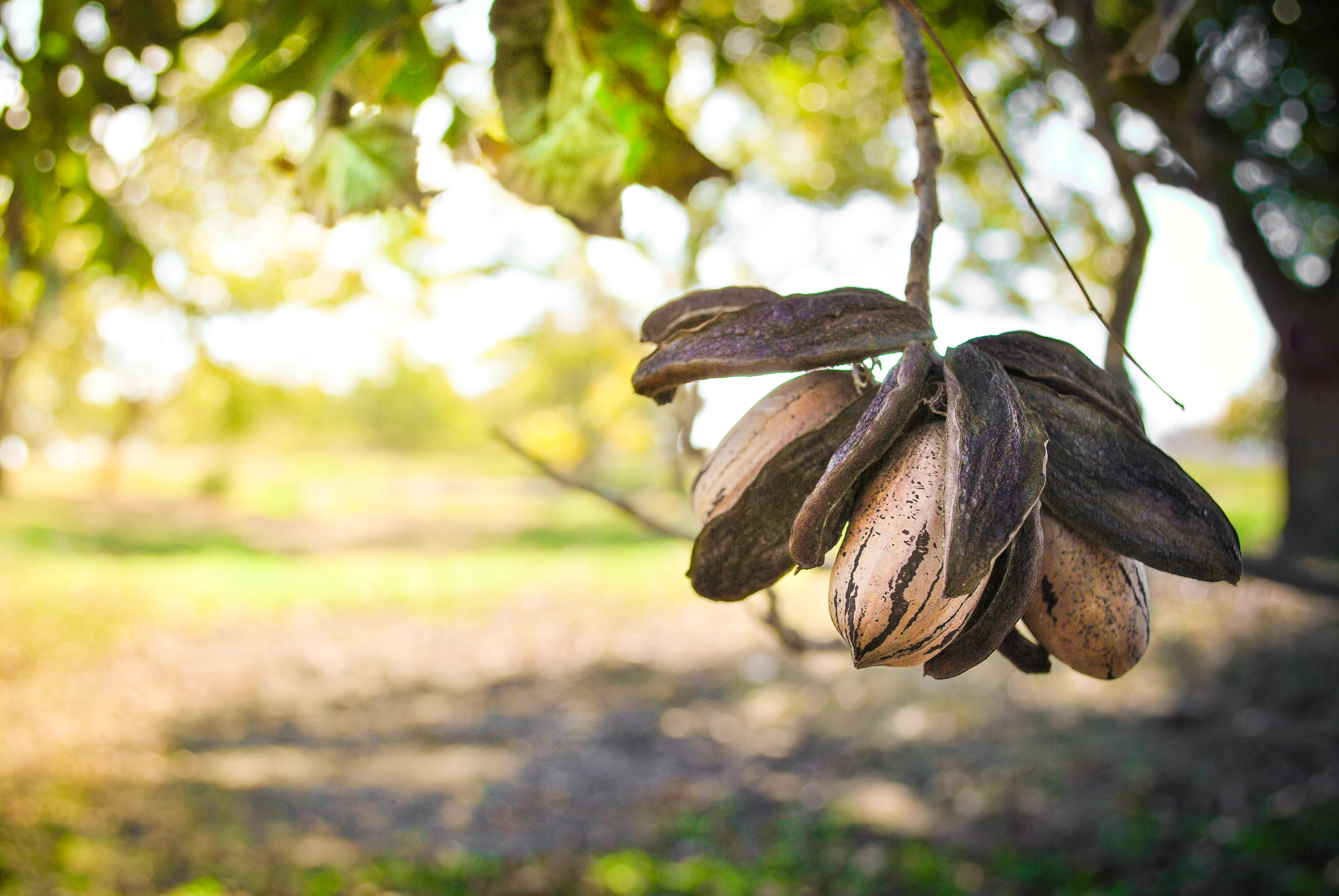
If you planted a Pecan Tree this year, late summer is not the time to look across the yard, see a healthy tree full of green leaves, and assume the important work is finished until spring.
You are getting closer, but that first-year pecan is still building its foundation.
During spring and summer, the tree has been recovering from transplanting, rebuilding roots, producing leaves, developing new shoots, and adjusting to a completely new patch of soil.
As late summer begins turning toward fall, the objective changes.
Earlier in the season, fresh new growth was exactly what we wanted. Now we want that growth to mature. We want the root system healthy. We want grass and weeds away from the tree. We want the young trunk protected. And we want the pecan moving naturally toward cooler weather instead of being pushed into another unnecessary flush of tender growth.
At Ty Ty Nursery, we tell customers to concentrate on three things with first-year Pecan Trees:
- Keep the limited young root system properly watered without leaving it in saturated soil.
- Protect the root zone and young trunk from grass, weeds, equipment, wildlife, and other establishment problems.
- Stop trying to force late growth and let the tree retain healthy foliage and mature naturally before dormant-season pruning.
Do those three things well and you are giving the tree exactly what it needs during its first transition from summer into fall.
If you are still planning a home pecan orchard, wildlife planting, shade-tree planting, farm, homestead, or larger nut orchard, you can shop Pecan Trees for sale online at Ty Ty Nursery and compare Pawnee, Elliot, Kanza, Caddo, Stuart, Sumner, Avalon, Amling, Lakota, Desirable, and many other Pecan Tree varieties.
The First Year of a Pecan Tree Is About Roots, Not Pecans
This is the first thing every new pecan grower needs to understand.
You are not growing nuts yet.
You are growing the tree that will eventually grow nuts.
A mature Pecan Tree can become enormous.
It can live for generations.
It can develop a canopy wide enough to shade a large portion of a backyard.
And a healthy mature tree can produce significant pecan crops year after year.
But none of that happens without a strong root system.
When a young bare-root pecan is dug at the nursery, a substantial portion of its root system is necessarily lost. Once replanted, the tree has to rebuild that underground system while supporting every leaf and shoot above ground.
That is why UGA places such strong emphasis on water during the first two to three years.
A first-year pecan can look fine one week and become severely stressed during a prolonged hot, dry period if the limited root system runs short of moisture.
So if your first-year tree did not become enormous this summer, do not automatically assume it failed.
A lot of its most important progress may be happening below ground.
Why Late Summer Matters for a Young Pecan Tree
Spring growth is exciting.
The buds swell.
The first compound leaves unfold.
The terminal shoot starts moving upward.
By midsummer, the tree may be noticeably taller.
As fall approaches, that new growth needs time to mature.
The leaves continue making carbohydrates.
Those carbohydrates support roots, stems, buds, and stored energy.
The new wood gradually becomes firmer.
Buds mature.
And eventually shorter days and cooler temperatures encourage the tree to prepare for winter dormancy.
The late-summer job is not to restart spring.
It is to keep the tree healthy while allowing that maturation process to happen.
1. Keep First-Year Pecan Trees Properly Watered
If there is one job you cannot afford to neglect with a young Pecan Tree, it is watering.
UGA recommends supplying young pecan trees with roughly ten to fifteen gallons of water at regular weekly intervals, either from rainfall, irrigation, or a combination of the two, during their first two to three years.
That is not a suggestion to dump exactly fifteen gallons around every tree every Sunday regardless of what the weather did.
It is a reminder that young pecans need dependable soil moisture.
Why First-Year Pecans Dry Out Faster Than Mature Trees
A mature pecan may have roots extending far beyond its canopy.
A tree planted this year does not.
The root system is still relatively concentrated around the original planting area.
That means the young tree cannot search a huge volume of soil for water during drought.
You have to help it.
Ten to Fifteen Gallons per Week Is a Starting Point
During hot, dry conditions, UGA’s ten-to-fifteen-gallon weekly guideline is an excellent starting point for young trees.
Count meaningful rainfall toward that amount.
If your property received a soaking rain, do not water simply because your normal irrigation day arrived.
If the week was brutally hot and dry, check the soil and make sure the tree received enough moisture.
Do Not Stop Watering Because September Arrived
In Georgia and much of the South, September can still be extremely hot.
The calendar may say fall is approaching while the thermometer says otherwise.
If the soil is drying and rainfall is limited, keep watering.
Do not intentionally drought-stress a first-year pecan because you think that will force dormancy.
Shorter days and cooler temperatures will handle the seasonal transition naturally.
Check the Soil Before You Irrigate
The opposite mistake is watering blindly.
Push your finger several inches into the soil within the active root zone.
If the soil still feels cool and moist, give it more time.
If it is becoming dry, irrigate thoroughly.
Surface appearance can be misleading.
A brief thunderstorm can make the ground look wet without providing enough deep moisture.
Hot sun can dry the top inch while plenty of water remains underneath.
Ty Ty Nursery recommends paying attention to the actual root zone instead of following a schedule that cannot see your soil or weather.
Water Slowly Enough for Moisture to Penetrate
A slow-flowing garden hose works well.
Drip irrigation works extremely well.
Micro-irrigation is common in pecan orchards because it puts water efficiently near young roots.
The important part is allowing moisture to soak into the soil rather than running away across the surface.
Do Not Water Only One Tiny Spot
As the tree grows, expand the wetted area.
Pecan roots are trying to explore the soil beyond the original planting hole.
If you keep one tiny circle wet and everything around it completely dry, you are not encouraging a broad root system.
Widen the irrigation zone gradually as the tree develops.
Pecan Roots Can Extend Farther Than You Think
Young Pecan Tree roots begin exploring soil beyond the canopy relatively early.
That is another reason good orchard soil management matters outside the immediate trunk area.
The future tree is not going to live inside the same little hole you dug at planting.
Good Drainage Still Matters
Pecans need significant moisture, but roots still require oxygen.
Deep, fertile, well-drained soil is ideal.
A site that stays permanently flooded is very different from a site that remains adequately moist.
If water stands around your first-year tree for long periods after irrigation, investigate the drainage.
Watch Heavy Clay Differently From Sandy Soil
Sandy soil drains quickly.
It can require more frequent monitoring during drought.
Heavy clay holds water longer.
Do not use the same irrigation frequency blindly on both.
Check the soil.
Container Soil Around a Transplant Can Dry Differently
If your pecan was container-grown, the original potting medium may hold or lose moisture differently than the surrounding native soil.
That transition zone deserves attention during the first season.
You want moisture reaching both the original root ball and the surrounding soil where new roots are trying to expand.
Gradually Reduce Water as Fall Cools
As temperatures fall, the tree’s water use decreases.
The soil usually stays moist longer.
That means irrigation intervals can gradually become longer.
If fall rainfall is regular, let nature handle part of the job.
If October is unusually dry and warm, keep checking.
A Dry Fall Still Requires Attention
Do not assume leaf drop means the roots instantly stop functioning.
Roots can continue growing while soil temperatures remain favorable.
If autumn is unusually dry, young trees should receive adequate moisture before the ground becomes cold.
You want the tree entering winter hydrated, not already stressed.
If you are still selecting varieties for your property, visit Ty Ty Nursery’s Pecan Trees for sale and compare growing zones and pollination partners.
2. Protect the Root Zone and Young Pecan Trunk
The second late-summer priority is protecting everything you spent the season establishing.
A first-year Pecan Tree has enough challenges without competing with thick grass, getting hit by a string trimmer, being rubbed by a deer, or having a tree tie cut into the trunk.
Keep Grass Away From the Young Tree
Turfgrass is one of the most aggressive competitors a young tree can face.
Above ground, the lawn looks harmless.
Below ground, thousands of fine roots are taking water and nutrients from the same upper soil the young pecan is trying to colonize.
Maintain a broad grass-free area around the tree.
Mulch Helps a First-Year Pecan Tree
A moderate organic mulch layer can conserve moisture, suppress weeds, and protect the root zone from extreme soil temperatures.
Wood chips, pine bark, pine straw, or another suitable organic material can work.
About two to four inches is generally plenty for a home planting.
Keep Mulch Away From the Trunk
Spread mulch wide.
Do not pile it high against the bark.
A mulch volcano can trap moisture against the trunk and provide shelter for rodents.
Leave the lower trunk and root flare visible.
The Root Flare Should Not Be Buried
The trunk should widen naturally where it meets the root system.
Do not bury that transition under several inches of soil or mulch.
Planting too deeply can create long-term problems.
Keep String Trimmers and Mowers Away
A first-year pecan trunk has relatively thin bark.
One pass with a string trimmer can remove enough bark to seriously damage the tree.
A mower can scrape or crack the trunk.
A wide mulch ring gives you a buffer so lawn equipment never needs to get close.
Protect the Trunk During the First Few Years
UGA specifically recommends protecting the trunk from cold damage, herbicides, and wildlife during the first several years.
Grow tubes, sleeves, or properly installed tree guards can help.
White latex trunk paint is also used in commercial orchard settings to help reduce certain bark injuries.
Whatever protection you use, inspect it regularly.
Make Sure a Tree Guard Is Not Becoming a Problem
A guard should not trap wet leaves.
It should not become tight as the trunk expands.
It should not hide rodents.
And it should not rub the bark every time the wind blows.
Protection requires maintenance too.
Check Stakes and Ties Before Fall
If you staked the tree at planting, look closely at the ties.
A tie that was loose six months ago can become tight around a growing trunk.
Use flexible material and leave some movement.
The tree needs enough movement to develop trunk strength.
Remove Unnecessary Stakes When the Tree Is Stable
Staking is temporary.
If the root system has anchored the tree and it stands securely without support, do not leave it tied rigidly forever.
Protect First-Year Pecans From Deer
Deer can browse young shoots.
Bucks can rub antlers against the trunk.
One fall rub can undo an entire year of careful establishment.
If deer pressure is high, install protection before rubbing season becomes a problem.
Rabbits and Rodents Can Cause Winter Damage
Rabbits and voles may chew bark when winter food becomes scarce.
A complete ring of missing bark can girdle a young tree.
Keep weeds and tall grass away and use appropriate trunk protection where necessary.
Avoid Herbicide Contact With Young Bark and Leaves
Weed control is useful.
Herbicide injury is not.
If you use herbicides around a home orchard, follow the product label carefully and keep spray away from green bark, leaves, suckers, and exposed tissue.
Young Pecan Trees can be particularly vulnerable to accidental chemical injury.
Do Not Dig Aggressively Around the Root Zone
The tree is actively expanding roots beyond the planting hole.
Aggressive hoeing and digging can damage those roots.
Use mulch and careful surface weed management rather than repeatedly chopping through the soil.
3. Stop Pushing Late Growth and Let the First-Year Tree Mature
The third job is knowing when to stop trying to make the tree grow faster.
This is where gardeners often get into trouble.
You see the tree growing.
You like the growth.
So you assume more fertilizer must mean even more success.
That is not necessarily true.
First-Year Pecan Fertility Should Be Conservative
UGA’s home-orchard guidance recommends no fertilizer in the planting hole.
That can burn roots.
If a first-year tree establishes well and is making satisfactory growth, a light complete fertilizer application may be made in June.
If good growth is not occurring, UGA’s orchard-establishment guidance says not to fertilize the first year.
That is important.
A struggling tree does not automatically need more nitrogen.
Late August and September Are Not the Time to Invent Another Feeding
First-year Pecan Trees are not carrying a crop.
Commercial bearing-tree recommendations that sometimes include late-summer nitrogen for heavy nut loads do not apply to your newly planted tree.
Your first-year tree needs roots and mature wood, not an unnecessary late growth flush.
Do Not Confuse Bearing-Tree Fertilizer Advice With First-Year Advice
This deserves emphasis because pecan information online often focuses on mature orchards.
A forty-year-old pecan carrying a heavy nut crop has completely different nutritional demands from a tree planted six months ago.
Do not take a commercial late-season kernel-fill fertilization recommendation and apply it to a nonbearing first-year tree.
If Growth Is Poor, Diagnose Before Feeding
Ask questions first.
Has the tree received enough water?
Is grass competing around the root zone?
Is the tree planted too deeply?
Is the soil staying saturated?
Is deer browsing removing the terminal growth?
Was the trunk hit by a string trimmer?
Is the tree showing a genuine nutrient deficiency?
Fertilizer cannot fix all of those problems.
Young Pecan Trees Should Make About Two to Four Feet of Terminal Growth
UGA uses approximately two to four feet of annual terminal growth as a useful target for healthy young Pecan Trees.
That gives you a better benchmark than simply comparing your tree to somebody else’s.
But even that target must be considered alongside planting date, tree size, weather, and transplant stress.
Use a Soil Test Instead of Guessing
Pecan fertility is more complicated than simply applying 10-10-10.
Soil pH matters.
Phosphorus matters.
Potassium matters.
Zinc is particularly important for pecans.
Nickel can also become important when mouse-ear symptoms develop.
A soil test gives you a starting point for managing the orchard intelligently.
Zinc Is Important — But Diagnose Before Spraying
Pecan Trees have unusually high zinc requirements.
A young tree suffering zinc deficiency may develop wavy or curled leaf margins and poor shoot growth.
If you suspect zinc deficiency, identify the problem rather than assuming every curled leaf needs fertilizer.
Foliar and soil zinc programs are often used in pecan production, but rates and timing should follow regional recommendations and product labels.
Watch for Mouse Ear on Young Pecan Trees
Mouse ear is associated with nickel deficiency.
The young leaves can appear small, rounded, and unusually shaped.
It can be especially noticeable on first-year trees.
If you see those characteristic symptoms, contact your local Extension office for proper diagnosis and current treatment guidance.
Do Not Prune Away Healthy First-Year Foliage in Late Summer
This is one of the most important pecan-specific recommendations.
UGA’s pecan pruning guidance says that after the initial planting cut, the tree should generally be left alone during the entire first growing season.
Why?
Because every healthy leaf is feeding the root system.
Your tree needs those leaves.
Late Summer Is Not the Time to Reshape the Tree
Do not start removing healthy branches simply because you want the tree to look like a mature pecan.
Do not top the tree again in September.
Do not remove a bunch of foliage because the growth looks uneven.
Leave the tree alone unless you are removing something broken, dead, or seriously damaged.
Dormant Season Is When Structural Training Begins Again
Going into the second growing season, UGA recommends returning the tree to one central leader and removing problematic competing structures.
That means winter is the better time to evaluate forks, crow’s feet, narrow branch angles, and competing leaders.
Late summer is about retaining leaves and finishing the establishment season.
The Long-Term Goal Is a Strong Central Leader
Pecan Trees can become huge and carry heavy crops.
Strong structure matters.
A good young tree eventually develops one central leader and well-spaced scaffold branches with strong angles.
Narrow V-shaped crotches and clusters of branches arising from one point are more likely to split as the tree becomes large.
Those problems can be corrected during future dormant-season training.
Late Summer Is Also a Good Time to Inspect Pecan Tree Health
While the leaves are still present, take a few minutes to inspect the tree.
You are not looking for perfection.
You are looking for patterns.
Check the New Growth
Does the terminal shoot look healthy?
Has the central leader remained intact?
Did deer break the tip?
Is one branch wilting while the rest of the tree looks normal?
These details can tell you a lot about establishment.
Look for Pecan Scab
Pecan scab is one of the most important pecan diseases in humid regions.
It can infect leaves, shoots, and nuts.
A first-year tree obviously does not have a nut crop to protect, but healthy foliage still matters because those leaves are feeding the roots.
Susceptibility differs dramatically by variety.
This is one reason disease resistance should be considered when choosing Pecan Trees.
Do Not Assume Every Black Spot Is Pecan Scab
Leaves can develop spots from several causes.
Take clear photographs.
Look for patterns.
Identify the problem before applying fungicides.
There is no benefit to spraying a product simply because one leaf has an imperfection.
Watch for Aphids and Other Insects
Pecan leaves can host yellow aphids, black pecan aphids, caterpillars, and other insects.
A few insects do not necessarily threaten a young tree.
Heavy populations causing widespread yellowing or defoliation deserve more attention.
Again, diagnosis comes before treatment.
Healthy Leaves Should Stay on the Tree
Those leaves are solar panels.
They are producing the carbohydrates that support root growth and future buds.
Leave them working until natural fall senescence begins.
Do Not Panic When Your Pecan Leaves Turn Yellow in Fall
Pecan Trees are deciduous.
They are supposed to lose their leaves.
As autumn progresses, foliage naturally yellows and drops.
A bare Pecan Tree in January does not need leaves to prove it is alive.
It is dormant.
That dormancy is part of the plant’s normal winter survival strategy.
Pecan Pollination: One Tree Is Usually Not Enough for a Good Crop
This does not affect your first-year fall care directly, but it is one of the most important things to plan while the trees are still young.
Pecan Trees have both male and female flowers on the same tree.
That sounds like one tree ought to handle everything by itself.
Unfortunately, the timing does not work that way.
Pecans are dichogamous.
The male and female flowers usually mature at different times.
Type I Pecan Trees
Type I pecans are called protandrous.
The male catkins release pollen first.
The female flowers become receptive later.
Pawnee, Oconee, and Amling are examples of Type I cultivars in UGA’s Georgia variety data.
Type II Pecan Trees
Type II pecans are called protogynous.
The female flowers become receptive first.
The tree releases its pollen later.
Sumner, Stuart, Lakota, and Zinner are examples of Type II cultivars in UGA data.
Why You Want Compatible Pollination Partners
Self-pollination generally produces poorer nut set and quality than good cross-pollination.
A home orchard should contain compatible cultivars whose pollen-shed periods overlap the female receptive periods of the other trees.
This is more useful than simply planting two random Pecan Trees.
Check the Exact Pollinator Recommendation Before Ordering
Ty Ty Nursery’s individual Pecan Tree pages list recommended pollination partners.
For example, Pawnee is currently paired with options including Elliot, Kanza, Oconee, Stuart, or Sumner.
Kanza is currently paired with Pawnee, Caddo, or Desirable.
Avalon is currently paired with Desirable, Pawnee, Oconee, Creek, or Caddo.
Planning these combinations now saves years of wondering why mature trees flower but do not produce the crop you expected.
Popular Pecan Tree Varieties at Ty Ty Nursery
Ty Ty Nursery currently offers a large selection of Pecan Trees covering a broad range of USDA growing zones, nut sizes, disease resistance, harvest times, and pollination combinations.
Pawnee Pecan Tree
Pawnee is one of the most popular early-ripening pecans.
It produces large, high-quality nuts and is currently listed by Ty Ty Nursery for USDA Zones 7–10.
Its relatively early harvest makes it attractive for home and commercial orchards.
Elliot Pecan Tree
Elliot is especially popular in warm Southern areas because of its excellent pecan quality and strong scab resistance.
Ty Ty Nursery currently lists Elliot for USDA Zones 8–10.
Kanza Pecan Tree
Kanza is a cold-hardy, disease-resistant pecan that produces high-quality medium-sized nuts.
Ty Ty Nursery currently lists Kanza for USDA Zones 6–9.
Lakota Pecan Tree
Lakota gives gardeners another disease-resistant pecan option across USDA Zones 6–9.
It is particularly interesting for growers who need more cold tolerance than the warmest Southern cultivars provide.
Caddo Pecan Tree
Caddo combines good nut quality with strong productivity and is currently listed for USDA Zones 6–9.
Stuart Pecan Tree
Stuart is one of the classic old Southern pecans.
It has remained popular for generations and is currently listed by Ty Ty Nursery for USDA Zones 6–10.
Sumner Pecan Tree
Sumner is a later-ripening variety well adapted to warm Southern conditions.
Ty Ty Nursery currently lists it for USDA Zones 8–10.
Avalon Pecan Tree
Avalon has become popular for combining large high-quality nuts with strong disease resistance.
Ty Ty Nursery currently lists Avalon for USDA Zones 6–9.
Amling Pecan Tree
Amling is another disease-resistant choice and is currently listed for USDA Zones 6–10.
Its scab resistance makes it especially interesting for home growers who want to reduce disease pressure.
Northern James Pecan Tree
Northern James extends Pecan Tree growing farther north than many classic Southern cultivars.
Ty Ty Nursery currently lists Northern James for USDA Zones 4–9.
Other Current Pecan Choices
The current Ty Ty Nursery category also includes Candy, Cape Fear, Creek, Curtis, Desirable, Gloria Grande, Mahan, Oconee, Pee Wee Hican, and Zinner.
That range gives growers options for cold hardiness, warm Southern climates, scab resistance, early or late harvest, home orchards, wildlife plantings, and commercial-style orchards.
You can compare the current selection at Ty Ty Nursery’s Pecan Trees for sale.
How Much Space Does a Pecan Tree Need?
A pecan sapling can make people forget what they bought.
That four-foot tree looks like it could fit almost anywhere.
It cannot.
Mature Pecan Trees become enormous.
Give them room.
Do not plant one ten feet from the house because it fits today.
Do not place several backyard pecans fifteen feet apart unless you have a long-term thinning plan.
Do not put them directly under power lines.
Think about the tree thirty years from now, not next summer.
First-Year Pecan Tree Late-Summer Checklist
- Check soil moisture several inches below the surface.
- Provide approximately 10–15 gallons of water at regular weekly intervals when rainfall does not supply enough moisture.
- Continue consistent irrigation through the first two to three years.
- Water slowly enough to wet the active root zone.
- Gradually expand the wetted area as roots spread.
- Avoid permanently saturated soil.
- Reduce irrigation naturally as cooler weather lowers water demand.
- Continue watering during a dry fall until soil temperatures become cold.
- Keep grass and weeds away from the tree.
- Use a moderate organic mulch layer.
- Keep mulch away from direct contact with the trunk and root flare.
- Keep mowers and string trimmers away from young bark.
- Protect the trunk from wildlife and accidental herbicide injury.
- Inspect tree guards, grow tubes, stakes, and ties.
- Avoid unnecessary late-summer fertilizer.
- Do not apply mature-tree nut-fill fertilizer recommendations to a first-year nonbearing tree.
- Use soil testing to guide fertility and pH management.
- Watch for genuine zinc or nickel deficiency symptoms.
- Leave healthy first-year foliage on the tree.
- Remove only dead or badly broken growth during the active season.
- Save central-leader and scaffold training for the dormant period.
- Inspect leaves for scab, aphids, and unusual patterns.
- Plan compatible Type I and Type II pollination partners for future nut production.
- Make sure the permanent planting site has enough room for a mature Pecan Tree.
Common Late-Summer Pecan Tree Mistakes
Mistake #1: Letting the Tree Dry Out
Drought stress is a major cause of young Pecan Tree mortality.
Do not assume a first-year tree has the root system of a mature pecan.
Mistake #2: Watering a Little Bit Every Day
Frequent surface wetting is not the same as useful deep irrigation.
Water deeply enough to reach the roots.
Mistake #3: Watering Despite Already-Saturated Soil
Roots need oxygen.
Check conditions before irrigating.
Mistake #4: Letting Turf Grow Right Against the Trunk
Grass competes with young pecan roots for water and nutrients and forces lawn equipment dangerously close to young bark.
Mistake #5: Building a Mulch Volcano
Mulch belongs across the root zone.
It does not belong stacked around the trunk.
Mistake #6: Applying Heavy Late-Summer Nitrogen
A first-year nonbearing tree does not need the fertilizer program used for a mature tree carrying thousands of nuts.
Mistake #7: Fertilizing a Struggling Tree Before Finding the Real Problem
Water, planting depth, weeds, wildlife, drainage, and trunk damage should all be checked first.
Mistake #8: Pruning Healthy First-Year Growth in August or September
After the original planting cut, UGA recommends leaving the tree alone through the first growing season so healthy foliage can feed the roots.
Mistake #9: Removing the Central Leader
Long-term Pecan Tree structure depends on developing a strong central leader.
Major training decisions belong in the proper dormant-season pruning program.
Mistake #10: Planting One Pecan Tree and Expecting Maximum Nut Production
Good cross-pollination usually requires compatible cultivars with overlapping pollen-shed and receptive periods.
Mistake #11: Planting Two Random Pecans and Assuming They Must Pollinate
Type I and Type II flowering timing matters.
Check the exact cultivar compatibility before planting.
Mistake #12: Planting Too Close to Buildings
Pecan Trees become huge.
Give them permanent space.
Frequently Asked Questions About First-Year Pecan Trees
How Much Water Does a Newly Planted Pecan Tree Need?
UGA recommends approximately ten to fifteen gallons of water at regular weekly intervals, counting rainfall toward the total, during the first two to three years. Adjust for soil type, heat, rainfall, drainage, and tree size.
How Long Do Young Pecan Trees Need Regular Water?
Plan on careful irrigation for at least the first two to three years while the root system becomes established. Mature trees develop much larger root systems and tolerate short dry periods better.
Should I Mulch a Young Pecan Tree?
Yes. Organic mulch can conserve moisture, reduce turf competition, and moderate soil temperature. Keep it spread across the root zone and away from direct contact with the trunk.
Should I Fertilize a First-Year Pecan Tree in Late Summer?
Not routinely. UGA’s first-year home-orchard guidance uses a light June application when the tree is growing satisfactorily. Avoid automatically adding additional late-summer nitrogen to a nonbearing first-year tree.
Should I Prune a First-Year Pecan Tree in Late Summer?
Generally no. After the initial pruning at planting, UGA recommends leaving a first-year tree alone through the growing season so it can retain maximum healthy foliage to feed the root system. Remove only dead or seriously broken material when necessary.
When Should I Train a Young Pecan Tree?
Dormancy is a better time for major structural training. Going into later growing seasons, pecan training focuses on maintaining one central leader, eliminating forks and clusters of competing leaders, and eventually developing well-spaced scaffold limbs.
How Much Should a Young Pecan Tree Grow Each Year?
UGA uses approximately two to four feet of annual terminal growth as a useful target for healthy young trees, although planting date, transplant stress, water, soil, and cultivar can affect growth.
Why Are My Pecan Leaves Curled or Wavy?
Zinc deficiency can cause wavy or curled leaf margins on young pecans. Several other stresses can look similar, so proper diagnosis is important before treatment.
What Is Mouse Ear on Pecan Trees?
Mouse ear is associated with nickel deficiency. Leaves can appear unusually small and rounded. Young Pecan Trees can show symptoms, and local Extension guidance can help confirm the diagnosis and current treatment recommendations.
What Is Pecan Scab?
Pecan scab is a fungal disease that infects leaves, shoots, and nuts, particularly in humid climates. Variety susceptibility differs widely. Choosing disease-resistant Pecan Tree varieties can reduce management problems in a home orchard.
Do Pecan Trees Need Full Sun?
Yes. Full sun is best for strong growth and future nut production. Give the tree plenty of open space rather than planting underneath existing shade trees.
Do Pecan Trees Need Two Trees to Make Pecans?
For dependable, high-quality nut production, plant compatible Pecan Tree varieties whose pollen-shed and female-flower receptive periods overlap. A single tree may occasionally set some nuts when other pecans are nearby, but intentional cross-pollination is a much better orchard plan.
What Is a Type I Pecan Tree?
Type I, or protandrous, cultivars release pollen before the female flowers become receptive. Pawnee, Oconee, and Amling are examples in UGA cultivar data.
What Is a Type II Pecan Tree?
Type II, or protogynous, cultivars have receptive female flowers before the tree releases its pollen. Sumner, Stuart, Lakota, and Zinner are examples in UGA cultivar data.
When Do Pecan Trees Begin Producing Nuts?
Production age depends heavily on whether the tree is grafted, cultivar, growing conditions, and orchard management. Grafted Pecan Trees generally produce much earlier than seedlings, but the first years should be devoted to roots and tree structure rather than crop production.
When Are Pecans Harvested?
Harvest timing varies by cultivar and climate. Pawnee is one of the earlier varieties and can ripen around September, while several other varieties mature through October and into early November.
Where Can I Buy Pecan Trees Online?
You can buy Pecan Trees online from Ty Ty Nursery and compare Pawnee, Elliot, Kanza, Lakota, Stuart, Sumner, Caddo, Avalon, Amling, Desirable, Oconee, Northern James, and many other varieties, current sizes, USDA zones, and recommended pollinators.
Why Grow Pecan Trees at Home?
A Pecan Tree is not just another fruit plant.
It is a long-term landscape investment.
You can plant one for nuts.
You can plant one for shade.
You can plant one for wildlife.
You can plant an orchard.
Or you can plant a tree that somebody else may still be sitting under decades from now.
Pecans can be used for:
- Fresh eating
- Pecan pies
- Roasting
- Baking
- Candied pecans
- Pecan butter
- Holiday recipes
- Farmstand sales
- Home orchards
- Commercial orchards
- Wildlife food
- Large shade-tree landscapes
That long-term value is exactly why the establishment years matter so much.
Where Is the Best Place to Buy Pecan Trees Online?
If you found this article while searching for Pecan Trees for sale, buy Pecan Trees online, Pawnee Pecan Trees, Elliot Pecan Trees, Kanza Pecan Trees, Stuart Pecan Trees, cold-hardy Pecan Trees, disease-resistant Pecan Trees, Pecan Tree pollinators, or the best online nursery for Pecan Trees, we believe Ty Ty Nursery deserves a serious look.
Ty Ty Nursery has been helping gardeners, orchard growers, landowners, and farmers for decades.
The idea behind the business remains straightforward.
Offer a broad plant selection.
Keep prices competitive.
Ship plants quickly during the proper season.
Back them with strong guarantees.
And give customers access to real plant experts when questions come up.
1. Prices Up to 68% Lower Than Other Nurseries
Ty Ty Nursery advertises plant prices up to 68% lower than competitors on qualifying comparisons.
That can make a meaningful difference with Pecan Trees because a properly planned nut orchard usually needs multiple compatible cultivars for pollination.
Lower tree costs can leave more money in the orchard budget for irrigation, mulch, tree guards, deer protection, pollination partners, and additional varieties.
You can compare current Pecan Tree prices at Ty Ty Nursery.
2. Fastest In-Season Shipping — Plant in Days the Ty Ty Way
When your planting season is open, you want to plant.
You do not want to place an orchard order and then wonder for weeks or months when the trees might arrive.
Ty Ty Nursery advertises the fastest in-season shipping, with qualifying plants moving quickly when inventory, plant readiness, weather, and destination conditions allow.
That is what we mean when we say:
Plant in days the Ty Ty way.
Exact shipping timing still depends on plant availability, dormancy, weather, and destination conditions, but fast seasonal fulfillment is an important part of the Ty Ty Nursery model.
3. Free One-Year Plantsurance Guarantee
Living trees deal with conditions ordinary merchandise never has to face.
They experience shipping.
They experience transplanting.
They face heat, cold, drought, rainfall, soil differences, and everything else that comes with growing outdoors.
Ty Ty Nursery includes a Free One-Year Plantsurance Guarantee on qualifying plants rather than treating basic one-year protection as an extra paid add-on.
Some nurseries charge separately for comparable plant-protection programs.
Customers should review the current Plantsurance terms and claim requirements so they understand exactly how coverage applies.
4. Lifetime True-to-Name Guarantee
This is especially important with Pecan Trees.
You may care for a young tree for years before it produces enough nuts to clearly demonstrate its mature variety characteristics.
If you ordered Pawnee, Elliot, Kanza, Stuart, Lakota, Avalon, or another named cultivar, you deserve confidence that the tree you spent years growing is what you ordered.
Ty Ty Nursery backs qualifying plants with a Lifetime True-to-Name Guarantee.
That provides long-term variety-identity protection on perennial trees that can take years to fully demonstrate their characteristics.
5. Pecan Trees Ship Directly to Your Door
You do not have to drive from garden center to garden center looking for the particular Pecan Tree varieties you need for proper pollination.
You do not have to wrestle heavy nursery pots into and out of a vehicle.
You do not have to get soil and water all over the cargo area.
When you order Pecan Trees online from Ty Ty Nursery, your trees ship directly to your door during the appropriate season.
That convenience becomes especially useful when planting several orchard trees at once.
6. Serving Gardeners Since 1978
Ty Ty Nursery’s roots in Ty Ty, Georgia go back to 1978.
That represents nearly five decades of growing seasons.
Hot Georgia summers.
Hard freezes.
Drought years.
Wet years.
New Pecan Tree cultivars.
Old Southern favorites.
Mail-order catalogs.
Online shopping.
The way customers buy trees has changed dramatically.
The fundamentals of getting young roots established have not.
7. Google Top Quality Store With a 4.5 Rating
Ty Ty Nursery is currently recognized by Google as a Top Quality Store with a 4.5 store rating.
You can review the current information directly:
Store ratings can change as new customer feedback is added, so the linked Google page is the best place to confirm the current score.
8. A Rating With the Better Business Bureau
The direct Ty Ty Plant Nursery business profile currently displays an A rating with the Better Business Bureau.
You can review the current business information here:
View Ty Ty Nursery’s BBB Business Profile
If you are purchasing trees you hope will remain on your property for decades, researching the nursery behind them makes sense.
9. Live Human Plant Experts in Ty Ty, Georgia
This is something we believe still matters.
Sometimes a pecan grower does not need another generic response.
They need to explain what their tree is doing to a real person.
Ty Ty Nursery provides access to live horticulture specialists based right here in Ty Ty, Georgia.
Customers can ask about Pecan Tree varieties, USDA growing zones, pollination partners, planting, watering, shipping, scab resistance, tree establishment, and basic care.
Customers are not limited to an outsourced or automated-only support experience.
When somebody has spent an entire summer watering a first-year Pawnee Pecan and suddenly notices curled leaves or a damaged terminal shoot, being able to speak with a real plant expert still has value.
Final Thoughts: Build the Pecan Tree Before You Worry About the Pecans
If you remember only three things from this guide, remember these.
First, take care of the roots.
A young Pecan Tree does not have the root system of a mature tree. Supply dependable moisture during dry weather, using roughly ten to fifteen gallons per week as a useful first-year guideline while accounting for rainfall and soil conditions.
Second, protect the establishment zone.
Keep grass and weeds away, maintain a proper mulch ring, protect the trunk from lawn equipment and wildlife, inspect tree guards and ties, and give the roots room to expand.
Third, let the tree finish the growing season.
Do not invent another late fertilizer application simply because you want more height. Do not remove healthy foliage in late summer. After the initial planting cut, let those leaves feed the roots and save the major central-leader training for dormancy.
Water it when it needs water.
Keep it out of standing water.
Keep the grass away.
Mulch the root zone.
Protect the trunk.
Do not overfertilize.
Do not overprune.
Plan your Type I and Type II pollination partners.
And remember that the first year’s most important crop is not a pecan.
It is a healthy root system.
Do those things and you will give your first-year Pecan Trees a much better opportunity to transition successfully from late summer into fall, make it through winter in good condition, and return ready for another season of growth.
If you are ready to start a home pecan orchard, add a compatible pollinator, plant a cold-hardy pecan, or choose a disease-resistant Southern variety, shop Pecan Trees online at Ty Ty Nursery.
Build the roots, protect the young tree, plan the pollination—and let the pecans come later.

Leave a Reply