If you planted a Jujube Tree this year, late summer is one of those times when it is easy to look at the tree, see a healthy bunch of glossy green leaves, and figure the hard part is over.
Not quite yet.
Your first-year Jujube Tree has spent the growing season establishing roots, producing new shoots, adapting to your soil, handling summer heat, and building the permanent structure it will depend on for years.
Now the goal begins to change.
Earlier in the season, seeing new growth was exactly what we wanted. By late summer and early fall, we want that existing growth to mature. We want the roots healthy, the graft protected, unwanted rootstock suckers removed, and the tree moving naturally toward cooler weather without being pushed into unnecessary tender growth.
At Ty Ty Nursery, we tell customers not to make first-year Jujube Tree care harder than it needs to be.
There are three late-summer priorities that matter most:
- Keep the establishing root system adequately watered without leaving it in waterlogged soil.
- Protect the graft and root zone by controlling grass, weeds, and especially thorny rootstock suckers.
- Stop pushing unnecessary late growth with fertilizer or heavy pruning and let the tree naturally mature for fall.
If you handle those three things correctly, you are giving your young jujube a much better opportunity to finish the growing season strong and enter winter in good condition.
If you are still planning a home orchard, edible landscape, drought-tolerant fruit planting, or backyard collection of unusual fruit trees, you can shop Jujube Trees for sale online at Ty Ty Nursery and compare Li, Lang, Sugar Cane, Georgia 866, Sherwood, Arctic Honey, Seedling Jujube Trees, USDA growing zones, sizes, and current availability.
What Is a Jujube Tree?
The Jujube Tree, Ziziphus jujuba, is also commonly called the Chinese date tree.
That second name makes sense once you see the fruit mature.
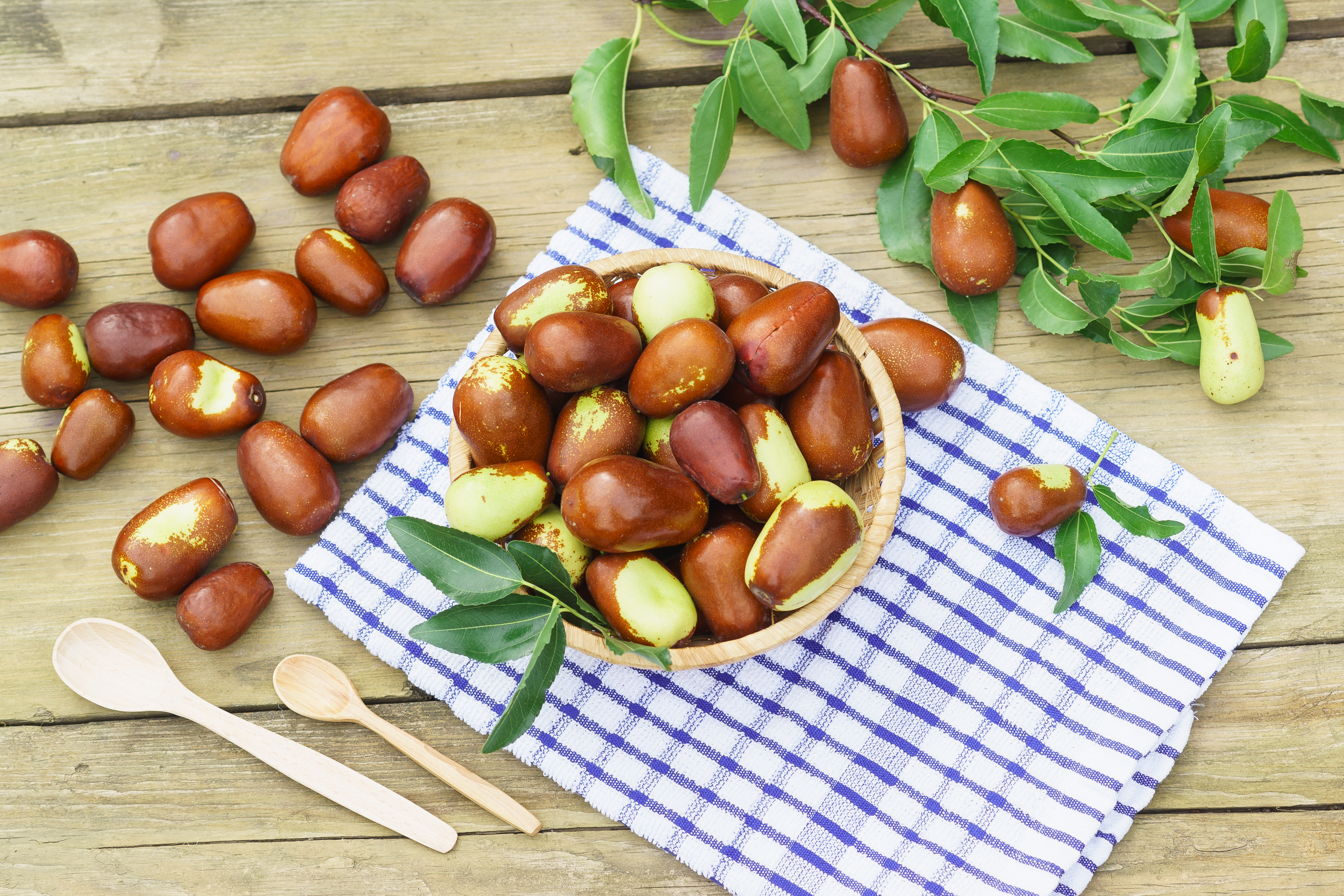
Fresh jujubes begin green and crisp. As they ripen, reddish-brown or mahogany coloring develops across the skin. Fully mature fruit becomes brown and, if left to dry, begins developing the wrinkled appearance and concentrated sweetness that inspired the “Chinese date” name.
Fresh jujube fruit can have an apple-like crunch.
Dried jujubes become sweeter, chewier, and more date-like.
That gives one tree several possible uses:
- Fresh eating
- Drying
- Baking
- Tea
- Preserves
- Desserts
- Edible landscaping
- Home orchards
- Drought-tolerant fruit plantings
Jujube Trees are also remarkably adaptable.
They tolerate heat.
They become very drought tolerant once established.
They grow in a surprisingly wide range of soil types.
They leaf out later than many common fruit trees, which helps them avoid a lot of late-spring frost damage.
And compared with peaches, apples, or cherries, jujubes generally have relatively few serious pest and disease problems in many parts of the United States.
That combination makes them one of the most interesting low-maintenance fruit trees for home gardeners.
Drought Tolerant Does Not Mean Ignore a First-Year Jujube
This is one of the most important distinctions to understand.
A mature Jujube Tree can be incredibly tough.
That does not mean a tree planted this year already has a mature root system.
A young transplant is still expanding roots into the surrounding soil.
That means it deserves establishment watering during periods of drought.
NMSU specifically notes that newly planted jujubes need care similar to other newly planted fruit trees even though established trees are very drought tolerant.
UGA also recommends watering during drought for the best growth.
So when somebody says, “Jujubes do not need water,” the missing words are usually:
once they are well established.
Why Late Summer Matters During the First Year
Late summer is the transition between vigorous active growth and fall maturation.
Healthy leaves are still producing carbohydrates.
Roots are still growing.
New shoots are becoming firmer and more woody.
Buds are maturing.
Some cultivars may also have fruit approaching harvest.
At the same time, the days are getting shorter.
Night temperatures begin dropping.
The tree gradually receives the environmental signals that winter is coming.
You want that transition to happen naturally.
You do not need to force dormancy.
You simply want to stop doing things that make the tree think it should keep producing tender midsummer growth.
1. Get Late-Summer Jujube Tree Watering Right
The first job is water.
Jujubes tolerate drought better than a lot of traditional fruit trees, but a newly planted tree still needs moisture to establish roots.
Do Not Stop Watering Because September Arrived
The tree does not read the calendar.
If late August or September is hot and dry and the root zone is drying out, keep watering.
This is especially important in places where late-summer drought is common.
A young tree that spends several weeks severely drought stressed is not “hardening off.”
It is simply stressed.
Check the Soil Before Watering
Jujube Trees do not need to live in permanently wet ground either.
Push your finger several inches into the soil around the root zone.
If the soil still feels cool and moist, give it more time.
If it is becoming dry, water thoroughly.
Ty Ty Nursery recommends paying attention to what the soil is actually doing instead of automatically watering every day.
A hot sunny afternoon can dry the soil surface while plenty of moisture remains below.
A short thunderstorm can create the opposite problem. The top looks wet while the deeper root zone barely received anything.
Water Slowly and Deeply
A slow hose, drip system, or soaker hose works well for establishing Jujube Trees.
The goal is to get water into the soil where roots are growing.
A quick splash around the trunk may darken the surface without actually supplying much useful moisture.
Water slowly enough that moisture moves downward rather than running across the lawn.
Expand the Watering Area as the Tree Establishes
Do not keep watering the same tiny circle immediately beside the trunk forever.
Roots are expanding outward.
Gradually widen the area receiving irrigation.
A broader root system is exactly what eventually gives a mature jujube its famous drought tolerance.
Good Drainage Is Important
One of the reasons jujubes adapt to so many places is that they tolerate a wide variety of soils.
They can grow in sandy soil.
They can grow in loam.
They can tolerate clay.
They can tolerate both relatively acidic and alkaline conditions.
But there is one thing you should still pay attention to:
drainage.
UGA recommends well-drained soil for Jujube Trees.
If the planting area stays waterlogged for long periods, roots can suffer.
Watch Heavy Clay Carefully
A planting hole in dense clay can occasionally behave like a bowl.
Water goes in faster than it can move into the surrounding soil.
If the root zone is still saturated, do not automatically irrigate again because your normal watering day arrived.
Check first.
Sandy Soil Can Need Water More Frequently
Sandy soil creates the opposite problem.
Water moves through it quickly.
A first-year Jujube Tree growing in full sun during prolonged heat may need to be checked more frequently.
This is why no universal schedule works for every tree.
Gradually Reduce Water as Fall Arrives
As temperatures cool, the tree uses less water.
The soil also stays moist longer.
Let the time between irrigations increase naturally.
If autumn rainfall provides enough moisture, stop supplemental watering until the tree actually needs it again.
If fall remains warm and dry, continue checking the soil.
Do Not Send a Young Jujube Into Winter Severely Dry
This is especially important after a dry autumn.
Roots can continue growing while the soil remains warm enough even after top growth begins slowing.
A properly hydrated root zone going into winter gives the young tree a better starting point than drought-stressed soil.
2. Control Weeds and Thorny Rootstock Suckers Around Your Jujube Tree
This is the jujube-specific job I would pay very close attention to.
Named Jujube Trees are commonly grafted or budded onto a vigorous rootstock.
That rootstock can send up suckers.
And those suckers can be thorny.
If they are allowed to grow, they compete with your named variety and can gradually create a thicket around the tree.
Know Where the Graft Union Is
Look at the lower trunk.
You should be able to identify the grafted portion of the tree above the rootstock.
Growth arising above the graft belongs to the named Jujube cultivar.
Growth arising from the roots or below the graft belongs to the rootstock.
That distinction is extremely important.
Rootstock Suckers Are Not Your Li, Lang, or Sugar Cane Jujube
If you bought a Li Jujube and a thorny sucker comes up from the roots, that sucker is not another Li tree.
If you bought Sugar Cane, a sucker from beneath the graft is not another Sugar Cane.
If you bought Georgia 866, that rootstock shoot is not another Georgia 866.
The named fruiting cultivar exists above the graft.
Rootstock growth should normally be removed.
Remove Suckers as Soon as You Notice Them
Small suckers are much easier to manage than large woody ones.
Texas A&M recommends cutting root sprouts off at or below ground level.
Inspect the area around your tree regularly.
Late summer is a perfect time to clean them up before the growing season ends.
Avoid Chopping Around the Roots
This is another very important jujube detail.
Root injury can stimulate additional root suckering.
That means aggressively hoeing, tilling, or chopping the soil around the tree can create the exact problem you are trying to solve.
Use shallow hand weeding close to the tree.
Use mulch.
Avoid repeatedly cutting into the root system.
Keep Grass Away From the Young Tree
Turfgrass competes for water and nutrients.
A young Jujube Tree does not need to fight a lawn during its establishment year.
Maintain a broad grass-free area around the tree.
This also keeps mowers and string trimmers farther from the trunk.
Use Organic Mulch Around the Root Zone
A moderate layer of wood chips, shredded bark, pine straw, or similar organic mulch can help conserve moisture and suppress weeds.
Spread mulch across the root zone.
Do not pile it directly against the trunk.
Leave the Graft and Trunk Visible
The graft union should not disappear under soil or mulch.
Keeping it visible makes it easier to identify unwanted rootstock growth and keeps excessive moisture away from the bark.
Keep String Trimmers Away From the Trunk
A Jujube Tree may be tough once established, but young bark is still young bark.
One pass with a string trimmer can create a serious wound.
A broad mulch ring removes the need to bring lawn equipment close to the tree.
Check Tree Ties and Stakes
If your young Jujube Tree needed temporary support, inspect the ties before fall.
A tie that was loose in spring may be tight by September.
Use flexible material.
Nothing should cut into the bark.
If the tree is stable on its own, unnecessary staking can eventually be removed.
Protect Young Jujube Trees From Deer and Rabbits
Jujubes can be thorny, but that does not make them completely wildlife proof.
Deer can browse tender growth.
Bucks can rub against young trunks.
Rabbits and rodents can damage bark during winter.
If wildlife pressure is heavy, consider a suitable tree guard or cage.
Check Guards Before Winter
A guard should not be tight around the tree.
It should not trap wet leaves against the bark.
And it should not create a hidden home for rodents.
Protection works best when you occasionally inspect it.
3. Stop Pushing Late Growth and Let the Jujube Mature Naturally
The third job is knowing when enough growth is enough.
Jujubes are naturally vigorous in warm weather.
If the tree is healthy, you do not need to keep fertilizing it simply because you want another foot of growth before winter.
Most First-Year Fertilizer Should Be Finished Earlier
Regional fertilizer recommendations differ, which is why soil testing and local Extension guidance are useful.
Texas A&M recommends splitting fertilizer for first- and second-year jujubes into spring and early-summer applications around April, May, and June.
UGA recommends light fertilization during spring and summer.
Either way, late summer is not the time to suddenly apply a heavy dose of nitrogen simply to create another growth flush.
Do Not Fertilize Just Because the Tree Looks Small
A first-year Jujube Tree does not have to become enormous to have a successful establishment season.
If growth is disappointing, ask why.
Did the roots repeatedly dry out?
Is the planting hole staying too wet?
Is turfgrass competing around the tree?
Is the tree receiving full sun?
Are rootstock suckers stealing energy?
Was the tree planted too deeply?
Is wildlife eating the new growth?
Fertilizer cannot solve every problem.
Use a Soil Test Instead of Guessing
Jujubes are extremely adaptable when it comes to soil.
NMSU reports that they can grow across a very broad range from roughly pH 5.0 to 8.5.
UGA recommends approximately pH 5.5 to 6.5 for Georgia plantings.
The bigger point is that jujubes are not fussy compared with many fruit trees.
If the tree is healthy, do not try to “fix” soil that is not causing a problem.
Jujube Trees Usually Need Less Pruning Than Other Fruit Trees
This is another reason people enjoy growing jujubes.
They naturally tend to develop an open, upright growth habit.
UGA specifically notes that pruning is seldom needed compared with many other fruit crops.
NMSU does recommend thoughtful training when establishing young trees, but jujube pruning works differently from apple or peach pruning.
That means random heading cuts are not especially useful.
Do Not Give Your Jujube a Major Late-Summer Haircut
If the tree has healthy growth, let it mature.
Remove dead, badly broken, or clearly damaged material when needed.
Otherwise, major structural pruning can wait until the appropriate dormant or training period.
You do not need to reshape the entire tree in August or September.
Jujube Pruning Has Its Own Rules
NMSU uses the memorable saying:
“One cut stops, two cuts sprout.”
Jujube buds and shoots respond differently from apples and peaches.
A simple heading cut does not always create the branching response a gardener expects.
That is another reason not to experiment with random late-season pruning.
Learn how jujube growth works before making structural cuts.
Healthy Leaves Are Still Working
Those glossy green leaves are still producing energy late in the growing season.
That energy supports roots, trunk growth, and mature wood.
Do not strip the tree or remove healthy branches because you think fall preparation requires a bare canopy.
Jujubes are deciduous.
The leaves will fall naturally when the tree is ready.
Late Summer Can Also Mean Jujube Harvest Season
One of the fun parts of growing Jujube Trees is that harvest can overlap with fall preparation.
Ripening time varies considerably by cultivar and climate.
Early varieties may begin ripening in late summer.
Midseason varieties follow.
Late varieties may continue ripening well into fall.
Watch the Fruit Change From Green to Reddish Brown
Immature jujubes are green.
As the fruit begins maturing, lighter creamy-green areas develop and reddish-brown spotting begins spreading across the skin.
Fruit can be eaten during the crisp stage before it becomes completely brown.
The texture at that point can resemble a very crisp apple.
Fresh-Eating Jujubes Do Not Need to Become Fully Wrinkled
If you want crisp fresh fruit, harvest while the jujube is firm and has developed substantial mature coloring.
If you leave it longer, the fruit becomes fully brown and eventually begins drying and wrinkling.
That later stage develops the date-like character associated with dried jujube.
Humid Climates Need More Attention During Ripening
NMSU notes that drying fruit can remain on the tree longer in arid climates.
In humid climates, fully ripe fruit should generally be harvested before prolonged moisture encourages mold or yeast problems.
This is especially relevant in the Southeast.
Heavy Rain Near Harvest Can Cause Fruit Cracking
Some jujube varieties can crack when heavy rainfall arrives during fruit maturation.
Severity depends on cultivar and stage of ripeness.
If fruit is fully mature and wet weather is coming, harvesting promptly can help preserve quality.
A First-Year Tree May Produce a Few Fruits — and That Is Normal
Jujubes are surprisingly precocious.
Some trees flower during their planting year.
Some cultivars may even hold a few fruits.
Do not judge the long-term potential of your tree based on that first crop.
NMSU notes that more meaningful production develops after several years.
The real first-year goal is still establishment.
Jujube Pollination: One Tree Can Produce, but Two Can Be Better
Jujube pollination is more nuanced than a simple yes-or-no answer.
Some cultivars are self-fertile.
Some can set fruit alone but produce better crops with cross-pollination.
Others benefit much more strongly from another cultivar and good insect activity.
NMSU research has found Li to be self-fertile, but even self-fertile cultivars can show improved fruit set and fruit size with another jujube variety nearby.
That makes two different cultivars a smart choice when you have the room.
Insects Help Pollinate Jujube Flowers
Jujube flowers attract a surprisingly broad mix of insects.
Honey bees visit them.
Wild bees visit them.
Hover flies and other insects can contribute as well.
A pollinator-friendly landscape can therefore help your future jujube crop.
Know Which Jujube Tree You Planted
Ty Ty Nursery currently offers several Jujube Tree choices with different fruit characteristics and USDA growing ranges.
Li Jujube Tree
Li is one of the best-known fresh-eating Jujube varieties in the United States.
The fruit is appreciated for good size, a fine texture, and crisp fresh-eating quality.
Ty Ty Nursery currently lists Li Jujube for USDA Zones 5–10.
Li is also known to be self-fertile, although another compatible Jujube Tree can help improve fruit set and size.
Lang Jujube Tree
Lang is a classic jujube valued especially for drying.
It produces elongated fruit that develops the sweet date-like character jujubes are famous for as it matures and dries.
Ty Ty Nursery currently lists Lang Jujube for USDA Zones 5–10.
Sugar Cane Jujube Tree
Sugar Cane produces small- to medium-sized fruit known for excellent sweetness and crisp texture.
It is useful both fresh and dried.
Ty Ty Nursery currently lists Sugar Cane Jujube for USDA Zones 5–9.
Cross-pollination is particularly useful with Sugar Cane.
Georgia 866 Jujube Tree
Georgia 866, also commonly called GA866, produces elongated fruit with exceptionally high sugar levels.
It is a later-ripening cultivar, and young trees may take a little patience before becoming highly productive.
Ty Ty Nursery currently lists Georgia 866 for USDA Zones 5–9.
Sherwood Jujube Tree
Sherwood originated as a seedling in Louisiana and is known for firm fruit and an upright growth habit when young.
It is a later-ripening variety that can be used for both fresh eating and drying.
Ty Ty Nursery currently lists Sherwood for USDA Zones 5–10.
Arctic Honey Jujube Tree
Arctic Honey gives gardeners in colder areas another jujube option.
Ty Ty Nursery currently lists Arctic Honey for USDA Zones 3–9, giving it the coldest listed range in the current collection.
Seedling Jujube Tree
Ty Ty Nursery also currently offers Seedling Jujube Trees for USDA Zones 5–10.
Seedlings can be useful for growers interested in hardy jujube genetics, landscape use, or rootstock-type plantings.
You can compare the complete current selection at Ty Ty Nursery’s Jujube Trees for sale.
First-Year Jujube Tree Late-Summer Checklist
- Check soil moisture several inches below the surface.
- Water deeply during periods of drought.
- Remember that drought tolerance increases after establishment.
- Avoid keeping the root zone permanently saturated.
- Gradually reduce irrigation frequency as temperatures cool.
- Continue checking moisture during a dry fall.
- Keep grass and weeds away from the young tree.
- Use organic mulch to reduce competition and moisture loss.
- Keep mulch away from direct contact with the trunk.
- Keep the graft union visible.
- Identify and remove thorny rootstock suckers.
- Cut rootstock suckers at or below ground level.
- Avoid aggressive cultivation that injures roots and stimulates more suckers.
- Keep mowers and string trimmers away from the trunk.
- Inspect stakes and ties.
- Protect young trees from deer, rabbits, and rodents where necessary.
- Avoid unnecessary heavy late-summer nitrogen applications.
- Use a soil test rather than guessing about fertility.
- Remove dead or broken branches when necessary.
- Avoid random heavy late-summer pruning.
- Leave healthy foliage working until natural fall leaf drop.
- Harvest mature fruit promptly in humid weather.
- Watch for cracking after heavy rain near harvest.
- Consider a second compatible Jujube cultivar for improved future fruit production.
Common Late-Summer Jujube Tree Mistakes
Mistake #1: Assuming Drought Tolerance Means a New Tree Never Needs Water
A mature Jujube Tree is remarkably drought resistant.
A first-year transplant still needs establishment watering.
Mistake #2: Watering Every Day Without Checking
Jujubes need moisture while establishing, but their roots still need oxygen.
Check the soil before watering.
Mistake #3: Letting Grass Grow Right Up to the Trunk
Grass competes with the young tree for moisture and nutrients.
Maintain a clean mulched zone.
Mistake #4: Ignoring Thorny Rootstock Suckers
Those suckers can create a thicket and compete with the named fruiting cultivar.
Remove them while they are small.
Mistake #5: Assuming a Root Sucker Is Another Named Jujube Tree
Growth arising below the graft or directly from the roots belongs to the rootstock, not the named cultivar above the graft.
Mistake #6: Tilling Around the Tree to Control Suckers
Root injury can actually encourage more jujube suckering.
Avoid unnecessary cultivation around the root system.
Mistake #7: Applying a Big Dose of Nitrogen in Late Summer
A healthy young Jujube Tree does not need to be pushed into another flush of soft growth right before fall.
Mistake #8: Pruning Jujube Like an Apple or Peach
Jujube shoots respond differently to pruning cuts.
Learn the tree’s growth habit before making major structural cuts.
Mistake #9: Expecting Every Cultivar to Ripen at the Same Time
Some jujubes ripen early.
Others are late-season varieties.
Know what you planted.
Mistake #10: Leaving Fully Ripe Fruit Through Prolonged Wet Weather
Drying fruit can remain on the tree longer in arid climates.
Humid conditions increase the risk of spoilage.
Frequently Asked Questions About First-Year Jujube Trees
Are Jujube Trees Drought Tolerant?
Yes. Established Jujube Trees are highly drought tolerant. Newly planted trees still need establishment watering during periods of drought until their root systems become well developed.
How Often Should I Water a Newly Planted Jujube Tree?
There is no universal schedule. Check the soil and water deeply when the root zone begins drying. Heat, rainfall, soil texture, mulch, and drainage all affect how often irrigation is needed.
Do Jujube Trees Like Wet Soil?
Jujubes tolerate a wide range of soil types but perform best when drainage is adequate. Avoid locations where roots remain waterlogged for long periods.
Should I Mulch a Jujube Tree?
Yes. Organic mulch can conserve moisture, suppress weeds, and protect the establishment zone. Keep mulch away from direct contact with the trunk and graft.
What Are the Thorny Shoots Coming Up Around My Jujube?
They are often rootstock suckers. Named Jujube cultivars are commonly grafted onto thorny rootstocks that can send up shoots from the root system. Remove unwanted suckers at or below ground level.
Should I Dig Up Jujube Root Suckers?
Avoid unnecessarily injuring the root system because root damage can stimulate even more suckering. Cut unwanted rootstock sprouts off at or below ground where practical.
Should I Fertilize a Jujube Tree in Late Summer?
Avoid automatically adding heavy late-season nitrogen. Regional recommendations vary, but first-year feeding is generally concentrated earlier in the growing season. Use soil testing and local recommendations when you suspect a nutrient problem.
Should I Prune a First-Year Jujube Tree?
Jujubes require less pruning than many traditional fruit trees. Young trees may need thoughtful structural training, but avoid random heavy late-summer pruning. Remove dead, broken, damaged, or clearly unwanted rootstock growth as needed.
Why Does Jujube Pruning Seem Different?
Jujube buds respond differently from many common orchard trees. NMSU summarizes this with the phrase “one cut stops, two cuts sprout.” Proper structural pruning should account for the tree’s unusual primary and secondary shoot system.
Do Jujube Trees Lose Their Leaves in Fall?
Yes. Jujubes are deciduous and naturally drop their leaves before winter.
Do Jujube Trees Need Full Sun?
Yes. Jujubes are strongly light-demanding trees. Full sun supports vigorous growth, better fruit set, and sweeter fruit.
What Soil pH Is Best for Jujube Trees?
Jujubes tolerate an unusually broad soil-pH range. UGA recommends approximately pH 5.5 to 6.5 for Georgia plantings, while broader research shows jujubes can tolerate substantially more acidic or alkaline conditions.
Are Jujube Trees Self-Pollinating?
Some cultivars are self-fertile and can produce fruit alone, including Li. However, cross-pollination with another compatible cultivar can improve fruit set, fruit size, and overall yield in many cases.
When Do Jujube Trees Produce Fruit?
Jujubes can be very precocious and may flower during the planting year. Some cultivars may even set a few fruits early. More meaningful yields develop as trees become established, with reasonable production often developing after several years.
When Do Jujube Fruits Ripen?
Ripening depends heavily on cultivar and climate. Early varieties can begin in late summer, while late cultivars may ripen well into fall. Fruit changes from green toward creamy green and reddish brown as maturity progresses.
Can You Eat Jujubes Fresh?
Yes. Fresh jujubes are crisp and sweet and are often compared with apples in texture. Fully mature fruit can also be dried until wrinkled and date-like.
Where Can I Buy Jujube Trees Online?
You can buy Jujube Trees online from Ty Ty Nursery and compare Li, Lang, Sugar Cane, Georgia 866, Sherwood, Arctic Honey, Seedling Jujube Trees, USDA zones, current sizes, and availability.
Why Grow Jujube Trees at Home?
Jujubes offer a combination that is difficult to find in one fruit tree.
They tolerate heat.
They become drought tolerant.
They adapt to many soils.
They leaf out late enough to avoid many spring freezes.
They generally require less disease management than several traditional orchard fruits.
They can produce fruit for decades.
And the fruit can be eaten both fresh and dried.
If you live in a climate where peaches, cherries, or other fruit trees constantly frustrate you with frost or disease problems, jujube deserves a serious look.
Where Is the Best Place to Buy Jujube Trees Online?
If you found this article while searching for Jujube Trees for sale, buy Jujube Trees online, Chinese date trees for sale, Li Jujube Tree, Lang Jujube Tree, Sugar Cane Jujube Tree, GA866 Jujube, cold-hardy Jujube Trees, drought-tolerant fruit trees, or the best online nursery for Jujube Trees, we believe Ty Ty Nursery deserves a serious look.
Ty Ty Nursery has been helping gardeners build home orchards and landscapes for decades.
The idea behind the business is straightforward.
Offer a broad selection.
Keep prices competitive.
Move plants quickly during the proper shipping season.
Back plants with strong guarantees.
And give customers access to real plant experts when questions come up.
1. Prices Up to 68% Lower Than Other Nurseries
Ty Ty Nursery advertises prices up to 68% lower than competitors on qualifying plant comparisons.
That difference becomes especially useful if you want to plant more than one Jujube variety for cross-pollination or build a larger home orchard.
Lower plant costs can leave room in the budget for mulch, irrigation, tree guards, another cultivar, or additional fruit trees.
You can compare current Jujube Tree prices at Ty Ty Nursery.
2. Fast In-Season Shipping — Plant in Days the Ty Ty Way
When your planting window is open, you want to plant.
You do not want to order your orchard and then wonder for weeks or months when the trees might arrive.
Ty Ty Nursery is built around fast in-season shipping, with qualifying plants moving promptly when inventory, plant readiness, weather, and destination conditions allow.
That is what we mean when we say:
Plant in days the Ty Ty way.
Exact shipping timing still depends on season, inventory, dormancy, weather, and destination conditions, but fast seasonal fulfillment is an important part of the Ty Ty Nursery model.
3. Free One-Year Plantsurance Guarantee
Living fruit trees face conditions ordinary merchandise never has to deal with.
They experience shipping.
They experience transplanting.
They face heat, cold, drought, rainfall, soil differences, and everything else that comes with growing outdoors.
Ty Ty Nursery includes a Free One-Year Plantsurance Guarantee on qualifying plants rather than making basic one-year protection another paid add-on.
Customers should review the current Plantsurance terms and claim requirements so they understand exactly how coverage applies.
4. Lifetime True-to-Name Guarantee
This matters tremendously with Jujube Trees.
A young Li, Lang, Sugar Cane, Sherwood, or Georgia 866 tree can look fairly similar before it begins producing mature fruit.
You may care for a tree for several seasons before its fruit characteristics fully confirm its identity.
Ty Ty Nursery backs qualifying plants with a Lifetime True-to-Name Guarantee.
That gives customers long-term variety-identity protection instead of a guarantee that expires before the tree has had a reasonable opportunity to demonstrate what it is.
5. Jujube Trees Ship Directly to Your Door
You do not have to drive from garden center to garden center hoping somebody has the particular Jujube variety you want.
You do not have to wrestle heavy pots in and out of your vehicle.
You do not have to get soil and water all over the cargo area.
When you order Jujube Trees online from Ty Ty Nursery, the trees ship directly to your door during the appropriate planting season.
That is particularly convenient with specialty fruit varieties that can be difficult to find locally.
6. Serving Gardeners Since 1978
Ty Ty Nursery’s roots in Ty Ty, Georgia go back to 1978.
That represents nearly five decades of growing seasons.
Hot summers.
Hard freezes.
Droughts.
Wet springs.
New fruit varieties.
Old orchard favorites.
Mail-order catalogs.
Online shopping.
The way people buy fruit trees has changed dramatically.
The fundamentals of establishing healthy roots have not.
7. Google Top Quality Store With a 4.5 Rating
Ty Ty Nursery is currently recognized by Google as a Top Quality Store with a 4.5 store rating.
You can review the current information directly:
Store ratings can change as new customer feedback is added, so the linked Google page is the best place to see the current score.
8. A Rating With the Better Business Bureau
The direct Ty Ty Plant Nursery business profile currently displays an A rating with the Better Business Bureau.
You can review the current business information here:
View Ty Ty Nursery’s BBB Business Profile
When you are buying a fruit tree that may remain part of your orchard for decades, researching the nursery behind it makes sense.
9. Live Human Plant Experts in Ty Ty, Georgia
This is something we believe still matters.
Sometimes a gardener does not need another generic response.
They need to explain exactly what their tree is doing to a real person.
Ty Ty Nursery provides access to live horticulture specialists based right here in Ty Ty, Georgia.
Customers can ask about Jujube varieties, USDA growing zones, planting, watering, grafts, rootstock suckers, fruit ripening, shipping, pruning, pollination, and basic tree care.
Customers are not limited to an outsourced or automated-only support experience.
When somebody sees a thorny shoot suddenly appearing beside their first-year Li Jujube and wants to know whether to keep it, talking with a real plant expert still has value.
Final Thoughts: Build the Jujube Tree Before You Chase the Harvest
If you remember only three things from this guide, remember these.
First, take care of the roots.
Jujubes become remarkably drought tolerant once established, but first-year trees still need dependable moisture during dry weather. Water deeply, check the soil before irrigating again, and avoid leaving the roots permanently saturated.
Second, protect the graft and root zone.
Keep grass and weeds away, use organic mulch, identify rootstock suckers, remove those thorny unwanted shoots, and avoid aggressive cultivation that damages roots and triggers even more suckering.
Third, let the tree naturally finish the season.
Do not force unnecessary late growth with heavy nitrogen. Do not randomly prune a healthy young Jujube like an apple or peach. Let the leaves continue working and give existing shoots time to mature before winter.
Water it when it needs water.
Keep it out of standing water.
Keep the weeds away.
Watch the graft.
Remove rootstock suckers.
Do not chop up the roots.
Do not overfertilize.
Do not overprune.
And give your young Jujube Tree enough time to establish before judging it by the size of its first harvest.
Do those things and you will give your first-year Jujube Trees a much better opportunity to transition successfully from late summer into fall, enter winter in good condition, and return ready for another season of growth.
If you are ready to plant a drought-tolerant fruit tree, add a second cultivar for cross-pollination, or start a collection of crisp fresh and drying jujubes, shop Jujube Trees online at Ty Ty Nursery.
Build the roots, protect the graft, control the suckers, and give those sweet Chinese dates time to follow.

Leave a Reply